When you’re laser-focused on reaching beyond the stars, it’s hard to remember more earthly, mundane tasks. That’s why we’re giving you an extra week to score early bird savings to TC Sessions: Space 2020 (December 16-17). So, to all you harried, procrastinating visionaries: take a breath, relax a bit and buy your pass before November 20 at 11:59 p.m. (PT).
Join the two-day online conference to hear from and connect with the leading forces within the space industry. Learn how to secure grants for your space company, how and where the Air Force plans to spend $60 billion on R&D, what savvy space investors think and where they might place their bets. And that’s just the tip of the rocket.
Presentations range from asteroid mining, extra-planetary robotic research and the future of space exploration to human spaceflight, manufacturing in space and supply-chain issues. Here are just two stellar examples, and you’ll find many more in the event agenda. Start planning your time now.
Bridging Two Eras of Human Spaceflight: When Kathryn Lueders started working at NASA in 1992, it was the peak of the Space Shuttle era. As she begins her leadership of the Human Spaceflight Office this year, a new and exciting era is just beginning. Lueders will discuss the possibilities and challenges of the new systems and technologies that will put the first woman and the next man on the surface of the Moon…and perhaps Mars.
Crafting the Kuiper Constellation: Amazon is set to create its own global constellation of LEO satellites — a very different type of gadget from what Amazon SVP of Device & Services Dave Limp is used to overseeing. He’ll tell us how Project Kuiper fits in with Amazon’s grand plans.
Looking for more ways to save? Bring the whole team with a group discount. Tickets cost $100 each — bring four team members and get the fifth one free. Discount passes for students cost $50, while current government, military and non-profit employees pay $95. Plus, Extra Crunch subscribers get a 20 percent discount.
Step into a virtual spotlight and showcase your startup in our expo. An Early-Stage Startup Exhibitor Package ($360 gets you three tickets, digital exhibition space and the ability to generate leads). Bonus: Exhibiting startups each get five minutes to pitch live to attendees around the world.
As you reach for the stars, connect with the experts and opportunities at TC Sessions: Space 2020 to help make your galactic dreams a reality. You have an extra week. Now, breathe, relax and buy your early bird pass before November 20 at 11:59 p.m. (PT).
Is your company interested in sponsoring TC Sessions: Space 2020? Click here to talk with us about available opportunities.
NextView Ventures, a Boston-based venture capital fund, has raised an $89.6 million fund, according to SEC filings. The firm’s fourth fund, its largest to date, is oversubscribed, with early documents indicating a $70 million goal. The NextView Ventures team did not immediately respond to request for comment.
NextView Ventures was launched in 2010 by Rob Go, a former partner at Spark Capital; Dave Beisel, who clocked time at Venrock and Masthead Venture Partners; and Lee Hower, a former investor at Point Judith Capital. Melody Koh joined as a partner three years ago, and most recently, the fund brought on former journalist Leah Fessler as an investor.
The fund, which has offices in New York as well as Boston, invests in consumer and software-as-a-service enterprise startups at the pre-seed and seed stage. Its portfolio includes Ellevest, an investing platform for women; Grove Collaborative, a sustainable goods subscription platform; and ThredUp, which has confidentially filed for IPO. In April, NextView launched a virtual accelerator for startups to build a more robust pipeline for deal flow. The firm invested $200,000 for an 8% equity stake in a number of pre-seed and seed startups focused on “the everyday economy.”
Despite the pandemic, Boston’s startup scene has continued to attract record numbers in venture capital volume. In fact, according to PitchBook data, Boston-area startups raised more private capital during summer 2020 than they did in summer 2019, suggesting that the pandemic has been a boon to startups in aggregate.
More recently, my colleague Alex Wilhelm and I wrote about how the Boston area is growing its demographic footprint in venture capital. In Q3 2019, New England drove 9.3% of U.S. venture deals, and 10.3% of U.S. venture dollars. In Q3 2020, those numbers were 9.3% of U.S. venture deals, and 12.7% of U.S. venture dollars. The percentage change is notable, especially amid volatile times.
NextView’s new fund is yet another signal of the city’s ability to attract institutional investment. Its previous fund was raised in 2017 at a $50 million close.
Reports that Dominion Software, which provides voting tabulation tools to about half the states in the U.S., “deleted” millions of votes have been soundly rebuffed after outgoing President Trump parroted numbers from a random internet forum.
Tweeting Thursday morning about baseless claims of election fraud, Trump cited OANN, a right wing news outlet, which itself seemed to have found its numbers in a thread on pro-Trump Reddit knockoff thedonald.win. (The tweet was quickly wrapped in a warning that the contents are disputed.)
The anonymous person posting there claimed to have compared numbers from Edison Research, a company that does exit polls and other election-related measures, to those from Dominion, and come up with very different sums. The methods are not very well explained, nor are the results. It’s not really clear what is being compared to what and why, or for what reason this alleged fraud was published publicly by the company supposedly perpetrating it. No one has verified (if that’s the word) this analysis in any way.
In a comment to Politifact, Edison President Larry Rosin wrote that “we have no evidence of any voter fraud,” and that it pretty much has no idea what the purported analysis is referring to.
Dominion attracted attention earlier in the week when it seemed that a glitch had caused a number of votes to be registered for President-elect Joe Biden instead of Trump. But the miscount was immediately caught and found to be the result of human error. The company has dedicated a page to combating the misinformation around its software.
Politifact rated Trump’s claim “Pants on Fire,” calling it “ridiculous” for good measure. It’s worth noting that the tweet didn’t even state the numbers of the supposed fraud correctly.
There doesn’t seem to be any merit to the “analysis” at all, but it provides an excellent example of how people who are unfamiliar with how the voting apparatus works — which is to say almost everyone not directly involved — tend to find the software portion inherently untrustworthy.
Yet there is no way to count, tabulate, and verify millions of ballots in hours or days after an election that does not rely heavily on private software tools, and it is in fact highly reliable and secure. The process of elections is bipartisan and extremely closely monitored.
Despite accusations from a dwindling number of highly placed individuals in the government, there has been no evidence presented that there was any significant voter fraud or other irregularities in last week’s election, which resulted in the victory of former Vice President, now President-elect Joe Biden.
President-elect Joseph Biden has plucked Ron Klain, a longtime colleague and confidant and the current executive vice president of the venture capital firm Revolution, as his White House chief of staff, reports The New York Times.
Klain was Biden’s chief of staff for two years during the Obama administration and left his post as chief of staff in 2011 to join Revolution, the firm founded by former AOL chief executive and founder Steve Case. Revolution did not immediately respond to a request for comment.
If Klain makes his second entrance into the White House, Biden will be bringing on a chief of staff he’s known for more than 35 years. The duo first worked together in 1989, when the president-elect was a senator and Klain was a newly graduated law student from Harvard Law School. He most recently worked as the White House Ebola Response coordinator from October 2014 to February 2015, and helped as a debate advisor to President Obama and President Clinton, as well as nominees Al Gore, John Kerry and Hillary Clinton.
Klain’s appointment could pacify some of the presumed tension that could occur between startups and the government under the Biden-Harris administration. Biden has been vocal about pursuing aggressive regulation on the tech industry, which could negatively impact behemoths like Google, Apple and Facebook. Klain has spoken up (in TechCrunch!) about how regulatory hurdles could hinder key innovation in startup-land. Klain also helped lead efforts for Higher Ground Labs, an incubator and accelerator focused on politically-focused (and Democrat-loved) startups. While that likely wouldn’t impact Big Tech, it doesn’t hurt that, reportedly, one of Biden’s closest confidants will have a soft spot for startups.
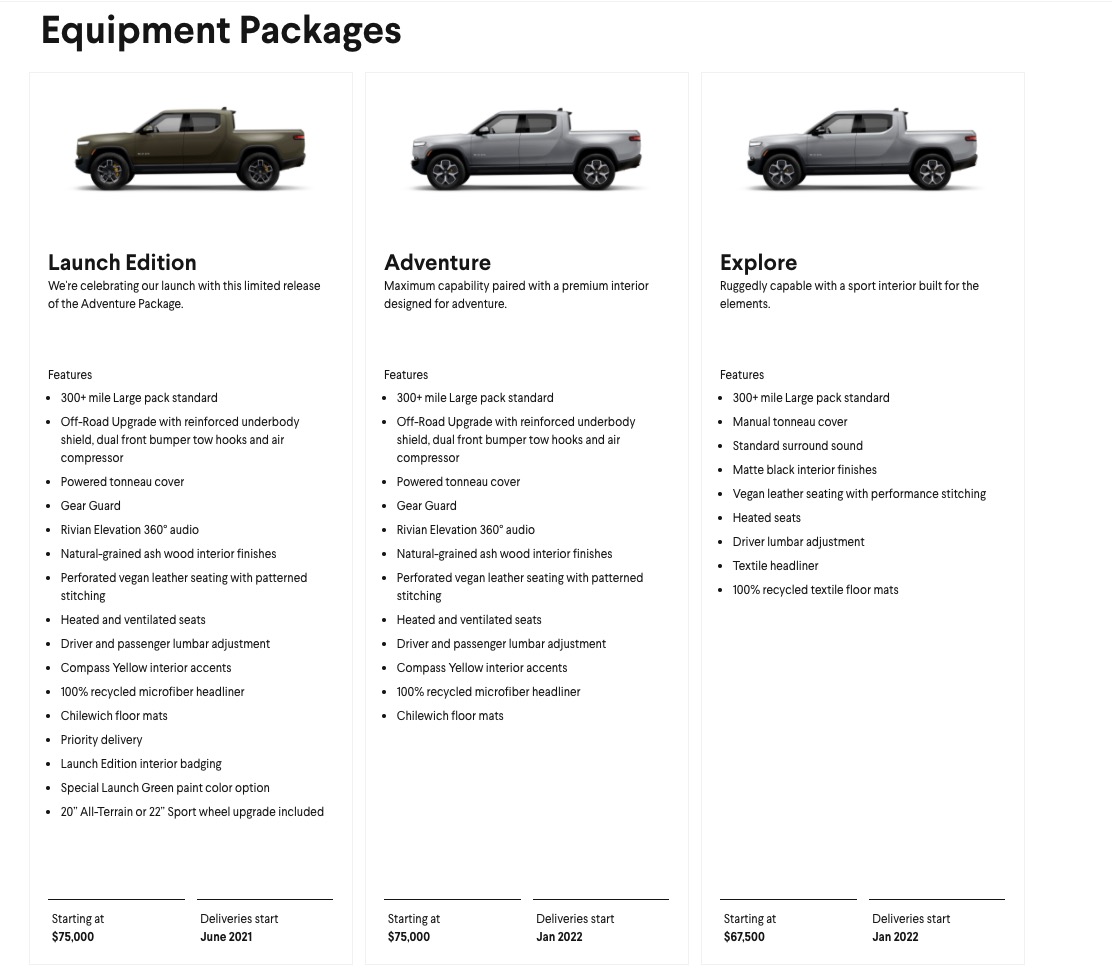
Rivian is opening up pre-orders for three editions of its upcoming electric pickup truck and SUV that start as low as $67,500 and with a battery range of more than 300 miles. However, more options will follow, including a base version that will have a smaller range of at least 250 miles and a price below $67,000.
Information on the three editions and their accompanying equipment packages, paint options and pricing is just a few of the numerous details released Wednesday on Rivian’s website. Perhaps one of the more notable tidbits include the addition of cheaper base version of the pickup and SUV, the official inclusion of the camp kitchen accessory and confirmation that a battery pack capable of more than 400 miles will be offered at some point in the future.
Rivian, which has attracted investment from the likes of Ford, Amazon, funds managed by BlackRock, T. Rowe Price and Associates and Cox Automotive, is aiming to become the first to bring an EV pickup truck to market. But it’s facing competition from legacy automakers such as GM as well as Tesla, which says it will start production of its futuristic looking Cybertruck in late 2021. Ford is also planning to bring an all-electric F-150 pickup truck to market in 2022.
Image Credits: Rivian
Deliveries of the first and, so far, most expensive version of the pickup truck called the Launch edition will begin in June 2021. The Launch edition of the RT1 truck will start at $75,000 (that’s before federal tax incentives are applied) and be able to travel more than 300 miles on the standard battery. The Launch edition will also have a special paint color called “Launch Green” along with other special badging and 20-inch all-terrain or 22-inch sport wheel upgrades included.
Tho other packages — the Adventure and Explore — will be offered for the RT1 truck and the R1S SUV. All of these versions will have more than 300 miles of range. The big differences come in the finishes. The Launch and Adventure editions, for instance, come standard with an off-road upgrade with reinforced underbody shield, dual front bumper tow hooks and air compressor as well as “compass yellow” interior accents, 100% recycled microfiber headliner and “Chilewich floor mats.”
The various pickup truck editions range between $75,000 and $67,500 in price. The R1S SUV prices range between $77,500 and $70,000. And all of these editions will arrive in the marketplace at different times between June 2021 and into January 2022.
Customers who place pre-orders now, which requires a $1,000 deposit, will have access to a configurator November 16. Everyone else will have access to the configurator, which allows customers to pick the paint color, equipment package and other details, on November 23.
The bigger 400-plus mile battery will come to the pickup truck first, starting in January 2022, according to Rivian. A longer range R1S SUV with both five- and seven-passenger seating will be announced following start of production, the company said on its website.
New research has found that San Francisco and London have become two of the world’s leading hubs for VC investment into tech solutions which address one or more of the 17 UN’s Sustainable Development Goals (SDG), more commonly referred to as ‘Impact Tech’. They are followed by Paris, Berlin, Stockholm, Shanghai and Beijing.
Tech solutions for such pressing issues as the climate crisis and social inequality has seen a 280% increase in global VC investment from 2015 to 2020, while investment in this space more than doubled in both cities over the past five years. The report was put together by London & Partners and Dealroom as part of this week’s Silicon Valley Comes to the UK virtual event. Over 5,000 startups were surveyed to create the data.
According to the research, VC investment into London-based impact tech start-ups has grown by almost 800% (7.8 times) since 2015, compared to 3.1 times in Europe as a whole. 2020 is set to be a record year for London’s impact tech companies, which have received $1.2bn in VC investment from January to October, already matching 2019 levels. London’s impact firms have also secured 429 deals between 2015 and 2020, more than any other city globally.
San Francisco’s impact based tech companies have also shown strong growth over the past five years, with the data revealing that VC investment into its impact tech companies has almost tripled (2.8 times) from 2015 to 2020. So far this year, SF-based impact tech companies attracted $1.7bn of VC investment in 2020 – more than any other city globally. At a national level, the United States received more VC funding for impact tech companies than any other country in the past five years, with investors pumping $35.8bn into US firms since 2015, double the amount invested into China ($16.8bn) and the United Kingdom ($6.1bn).
The research also found that UK capital has produced 241 impact start-ups since 2006, with 95 companies founded in San Francisco. In London, ‘impact unicorns’ include Octopus Energy (green energy), Arrival (zero-emission, public transportation vehicles) and Gousto (food) and Babylon Health (AI healthtech).
Climate change and clean energy solutions have attracted the most interest from investors in both cities, making up over 50% of overall VC investment over the last five years. Funding rounds including at least one North American investor made up $234m of VC investment so far this year in London, up from $85m in 2018, and equating to a fifth of all VC investment into London’s impact startups.
Funding rounds for London impact companies involving North American investors in 2020 include a $118m growth equity round into Arrival by Blackrock, an $80m Series B round for COMPASS Pathways and a $25m Series C funding for Tractable.
Meanwhile, Impact startups are crossing the pond in both directions. Arrival is now operating in Los Angeles, while Octopus Energy launched in the US market in September after closing a $360m funding round in April and acquiring Silicon Valley-based startup Evolve Energy. And San Francisco-based Allbirds, the sustainable shoe retailer, opened its first European flagship store in London in July 2018.
Commenting, Janet Coyle, managing director for business, London & Partners said: “San Francisco and London are two of the world’s top hubs for innovation and technology. But today’s figures also show that they are leading the way in creating purpose-driven companies striving to tackle some of the most pressing environmental and social challenges.”
Electric automaker Rivian will makes its hands-free driver assistance system standard in every vehicle it builds, including its first two vehicles — the RT1 pickup truck and R1S SUV — that are coming to market in 2021.
Details about the system, which is branded as Driver+, was just one of numerous new bits of information released Wednesday on its website, including prices and specs on its R1T pickup truck and R1S SUV.
Rivian said the driver assistance system will automatically steer, adjust speed and change lanes on command. The capabilities of the system that Rivian describes suggests it is a Level 2 system as designated by SAE International. Level 2 means the system can perform two or more parts of the driving task under supervision of the driver. To support this level of driving, the system will be powered by two redundant compute platforms, 12 ultrasonic sensors, 10 exterior cameras, five radars and high-precision GPS. This essentially gives the vehicle 360-camera and radar visibility. It’s robust suite of hardware that exceeds what Tesla uses for its driver assistance system. The hardware suite is similar to GM’s hands-free Super Cruise system with the exception that Rivian appears to have more cameras.
Rivian is also placing driver-monitoring system that includes a cabin-facing camera in its vehicles to ensure that drivers keep their eyes on the road when the system is engaged. Initially, the hands-free system will only be available on select highways and then expand over time — improvements achieved via over-the-air software updates — to include a broader geographic area and more road types. This is similar to GM’s approach with its hands-free Super Cruise system, which was initially limited to certain divided highways and eventually expanded.
While there are a number of automakers with Level 2 systems, they vary in capability. GM’s hands-free Super Cruise and Tesla’s Autopilot systems are considered some of the most capable and easy to use, per a recent Consumer Reports evaluation of driver assistance systems. However, Tesla’s system scored lower overall because it lacks a driver monitoring system that makes sure the driver is alert and paying attention to the road.
Ray Holgado, a former employee of the Chan Zuckerberg Initiative, recently filed a racial discrimination complaint with the California Department of Fair Employment and Housing. Holgado, who is Black, worked at CZI from September 2018 through August 2020.
“Despite its social justice rhetoric, CZI is not a welcoming environment for Black employees,” Holgado’s complaint states. “Black employees are underpaid, undervalued, denied growth opportunities, and marginalized. Black employees who want to advance within the organization are shut down and labeled as too assertive or aggressive, while non-Black employees are favored and encouraged. When Black employees have communicated these concerns to CZI leadership, CZI has responded defensively and failed to address the underlying issues. CZI has utterly failed to ‘build a more inclusive, just, and healthy future’ for its Black employees.”
In his complaint, Holgado alleges he was paid less than some of his colleagues doing similar work to him. According to the complaint, a recruiter denied Holgado’s request to negotiate his salary but later found out other, non-Black employees had been able to negotiate a higher salary. Holgado went on to describe other instances in which he was allegedly denied opportunities for promotions and growth, and was treated differently because of his race.
In addition to his own experiences, Holgado says the alleged issues of discrimination at CZI are systemic. According to the complaint, Holgado told CZI co-founder Priscilla Chan that the organization’s approach to diversity was successful in retaining Black people but didn’t do enough to empower Black employees “or integrate their perspectives into the work,” the complaint states. In response, according to the complaint, Chan acknowledged it was concerning but said “DEI may look different for each of us.”
In a statement to TechCrunch, CZI denied the claims.
“While we take any allegation of discrimination seriously and will do so here, this former employee’s specific allegations were previously raised internally, independently investigated, and found to be unsubstantiated,” the spokesperson said. “The Chan Zuckerberg Initiative is committed to fair treatment, access, and advancement for all members of the CZI team. We do not tolerate discrimination of any kind, full stop.”
“Unfortunately, Chan once again failed to grasp the seriousness of the issues the letter raised, refusing to meet several of the group’s requests, most notably declining to provide transparency into CZI’s pay equity data as it related to Black employees,” Holgado wrote today on the National Committee for Responsive Philanthropy.”Instead of working through the plan of action that was put forth by Black employees, she tasked a recently hired chief operating officer with devising and implementing an alternative course of action. Having witnessed the dynamics of passing the buck and placating employees with half measures play out multiple times at the foundation, I recognized that further efforts would be in vain.”
TechCrunch has reached out to CZI and will update this story if we hear back.
In the past several weeks we’ve seen refreshes and product expansions from about every facet of the smart home virtual assistant world. Apple launched the HomePod Mini, Google offered a long-overdue refresh of the Google Home, and Amazon found even more speaker shapes to shove Alexa into.
Today, we’re getting an addition from a startup competitor. Josh.ai has aimed to build out a niche in the space by building a smart assistant product that’s designed to be professionally installed alongside other smart home wares and they announced a new product this afternoon.
The device, Josh Nano, fully buys into a more luxury home-focused niche with a low-profile device that appears to be a little bit bigger than a half-dollar, though the bulk of the device is embedded into the wall itself and wired back to a central unit via power-over-ethernet. The device bundles a set of four microphones eschewing any onboard speaker, instead opting to integrate directly with a user’s at-home sound system. Josh boasts compatibility with most major AV receiver manufacturers in addition to partnerships with companies like Sonos. There isn’t much else to the device, a light for visual feedback, a multi-purpose touch sensor, and a physical switch to cut power to the onboard microphones in case users want extra peace of mind.
Image via Josh.ai
The aim of the new hardware is to hide the smart features of a home and move away from industry standard touch screen hubs with dated interfaces. By stripping down a smart home product to its essential feature, Josh.ai hopes it can push more users to buy in more fully with confidence that subsequent hardware releases won’t render their devices outdated and ugly. The startup is taking pre-orders for the device (available in black and white color options) now and hopes to start shipping early next year.
Powering these devices is a product the company calls Josh Core, a small server which basically acts as a hub for everything Josh talks to in a user’s home, ensuring that interactions between smart home devices can occur locally, minimizing external requests. The startup will also continue selling its previously released Josh Micro which integrates a dedicated speaker into the wall-mounted hardware.
Though Josh.ai partners directly with professional installers on the hardware, the startup has been scaling as a software business, offering consumers a license to their technology on an annual, 5-year or lifetime basis. The price of that license also differs depending on what size home they are working with, with “small” rollouts being classified as homes with fewer than 15 rooms. In terms of hardware costs, Josh.ai says that pricing varies but for most jobs, the average cost for users works out to be something like $500 per room.
Massive tech companies naturally design their products for massive audiences. For startups like Josh.ai this fact provides an in-road to design products that aren’t built for the common needs of a billion users. In fact, the selling point for plenty of their customers comes largely from the fact that they aren’t buying devices from Google, Amazon or Apple and hard-wiring microphones that feed back to them inside their home.
Though 95% of the startup’s business today focuses on residential, going forward, the company is also interested in scaling how their tech can be used in commercial scenarios like conference rooms or even elevators, the startup tells me.
Bill Zhang lowered himself into lunges on a squishy mat as he explained to me the benefits of the full-body training suit he was wearing. We were in his small, modest office in Xili, a university area in Shenzhen that’s also home to many hardware makers. The connected muscle stimulator attached to the suit, called Balanx, is designed to bring so-called electronic muscle stimulation, which is said to help improve metabolism and burn fat.
“We are not really aiming at Chinese consumers at this point,” said Zhang, who started Balanx in 2014. “The suit is for the more savvy consumers in the West.”
Prospects for hardware makers were looking bright until two years ago when the Trump administration began setting trade barriers on China. Relations between the two countries have been deteriorating over a series of flashpoint events, from Beijing’s policy on Hong Kong to the coronavirus pandemic.
Chinese entrepreneurs don’t expect relationships between the countries to warm up anytime soon, but many do believe the new office will make “less erratic” and “more rational” policy decisions, according to conversations TechCrunch had with seven Chinese hardware startups. Chinese tech businesses, big or small, are adapting swiftly in the new era of U.S.-China competition as they continue to woo overseas customers.
Designed in China
Zhang is just one of the many entrepreneurs looking to bring state-of-the-art Chinese hardware to the world. This generation of founders no longer hawk cheap electronic copycats, the image attached to the old “Made in China” regime. Decades of knowledge transfer, product development, manufacturing, export practice and policy support have made China a powerhouse for producing new technologies that are both edgy and still widely affordable.
Anker’s power banks, Roborock’s vacuums and Huami’s fitness trackers are just a few items that have gained loyal followings in several overseas markets, not to mention global household names like Huawei, Xiaomi, Oppo and DJI.
Consumer sentiment is also changing. Europeans’ perception of “Made in China” quality and innovation has “improved significantly” over the last 10 to 15 years, said Frank Wang who oversees marketing at Xiaomi-backed Dreame which makes premium home appliances including cheaper alternatives to Dyson hairdryers and vacuums.
The new players are eager to replicate the success of their predecessors. They seek media attention and retail partners at international trade fairs like CES, teach themselves Facebook and Google campaigns, and court gadget lovers on crowdfunding platforms. Investors ranging from GGV Capital to Xiaomi rush to back scrappy startups that are already shipping millions of units around the globe.
For Donny Zhang, a Shenzhen-based electronics parts supplier to hardware companies, businesses have been shrinking as soon as the trade war began. “My clients are taking the brunt because the costs of procurement have increased,” he said of those who directly or indirectly deal with American firms.
While many export-led hardware businesses loathe decreasing profitability, some learn to adapt and look for a silver lining. That has unexpectedly spurred new directions for factory owners in China. Indiegogo, one of the world’s largest crowd-funding platforms, saw the changes first hand.
“Once tariffs increase, there’s not much profit margin left for manufacturers because the middlemen already eat up the bulk of their profit,” Lu Li, general manager for Indiegogo’s global strategy, told TechCrunch.
“A good solution is for factories to skip the middlemen and sell directly to consumers with their own brands. Once the goal of brand building is clear, they often come to us because they need marketing help as a first step to establish themselves as a global consumer brand.”
The trend, dubbed “direct-to-consumers” or D2C, also plays into China’s national plan to encourage manufacturing upgrade and homegrown innovations to compete globally, an initiative that began to take shape around 2015. The development naturally makes China Indiegogo’s fastest-growing region in the last two years: in the first three quarters of 2020, businesses coming from China jumped 50% year-over-year, according to Li.
Localize
Having an appealing product and brand is just the prerequisite. Ever-changing trade policies and geopolitics have forced many Chinese businesses to localize seriously, whether that means setting up a foreign entity or building a local team.
For Tuya, which provides IoT solutions to device makers around the world, the trade war’s effect has been “minimal” since it has operated a U.S. entity since 2015, which employs its local sales and technical support staff. Most of its research and development, however, still lies in the hands of its engineers in India and China, the latter of which can be a potential contention point, as shown by TikTok’s recent backlash in the U.S.
“The key is compliance. We have a dedicated team of security experts to work on compliance issues. For instance, we were one of the first to get GDPR certified in Europe,” said the company’s chief marketing office Eva Na.
The company’s readiness is prompted by practical needs though. Many of its clients are large Western corporations that demand strict legal compliance in vendors, so Tuya began collecting the needed certificates early on. Connecting 200,000 SKUs today, Tuya’s footprint is found in over 190 overseas countries, which account for over 60% of its business.
Well-funded Tuya may have the financial and operational capacity to sustain an overseas team; but for smaller startups, localization can be a costly and tedious learning curve. Many opted to set up a Hong Kong entity to tap the city’s status as a global financial hub and evade trade restrictions on China, an advantage of the territory that began to crumble following Beijing’s implementation of the national security law.
Balanx, the smart training suit maker, has a Hong Kong entity like many of its export-facing hardware peers. To cope with new global headwinds, it registered a virtual company in Nevada but quickly realized the entity is of little use unless it has an on-the-ground operation in the U.S.
“Many local banks would ask for utility bills and etc. if I want to open an account, which we don’t have. We realized we must have a local team,” asserted the founder.
Hope
Zhang is positive that small companies like his own will remain under the radar in spite of U.S. sanctions. “Just avoid having any government connection,” he said.
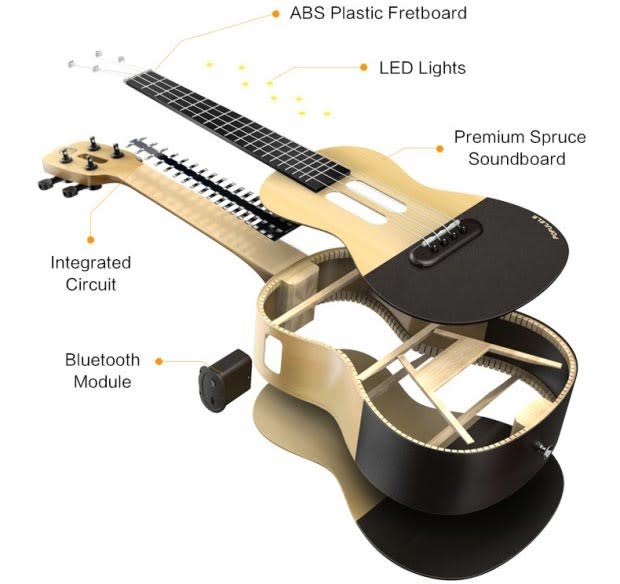
Indeed, some of the more “benign” and niche products are continuing to thrive in their global push. PopuMusic, a Xiaomi-backed startup making smart instruments like ukulele and guitar to teach beginners, is one. “We aren’t affected by the trade war. We are in a business that’s neither threatening nor aggressive,” said Zhang Bohan, founder of PopuMusic, which counts the U.S. as one of its biggest overseas markets.
Chinese brands are also seeing their edge as the coronavirus sweeps across the globe and confines millions at home. Hardware makers like Balanx, Dreame and PopuMusic have long learned to master e-commerce and logistics in a country where online shopping is ubiquitous.
“Consumers in Europe and the U.S. are growing more accustomed to e-commerce, a bit like those in China five to eight years ago,” said Wang of Dreame.
Rather than rethinking the U.S., PopuMusic is forging further ahead by launching a new connected guitar via an Indiegogo campaign. Global expansion is at the core of the startup’s vision, the founder said. “We are global from day one. We had an English name before even coming up with a Chinese one.”
In the process of making big bucks, hardware makers may have to downplay their “Made in China” or “Designed in China” brand, said Li of Indiegogo. This could help them avoid unnecessary geopolitical complications and attention in their international push. But one has to wonder how this new generation of entrepreneurs is reckoning with their national pride. How do they deal with the mission passed down by Beijing to promote Chinese innovation in the global marketplace? It’s a line that Chinese entrepreneurs have to tread carefully in their global journey in the years to come.
It’s somewhat complicated to do this, not least because they are sprawled across a number of Tencent properties and, unlike Ant, don’t go by a single brand or operational structure — at least, not one that is obvious to the outside world.
However, when you tease out Tencent’s fintech activity across its wider footprint — from direct operations like WeChat Pay through to its sizeable strategic investments and third-party marketplaces — you have something comparable in size to Ant, and in some services even bigger.
Hidden business
Ant refuted the comparison with Tencent or anyone else. In a reply to China’s securities regulator in September, the Jack Ma-controlled, Alibaba-backed fintech giant said it is “not comparable” to WeChat Pay, the fintech tool inside WeChat, Tencent’s flagship messenger.
“In the space of digital payments and merchant service, there are many players around the world, including Tencent’s WeChat Pay. But the payments services offered by these companies are different from our digital payments and merchant services. They are not comparable. In terms of digital finance, our way of working with and serving financial institutions, as well as our revenue model, are novel and do not have a counterpart,” the company noted in a somewhat hubristic reply.
There’s no denying that Ant is a pioneer in expanding financial inclusion in China, where millions remain outside the formal banking system. But Tencent has played catch-up in digital finance and made major headway, especially in electronic payments.
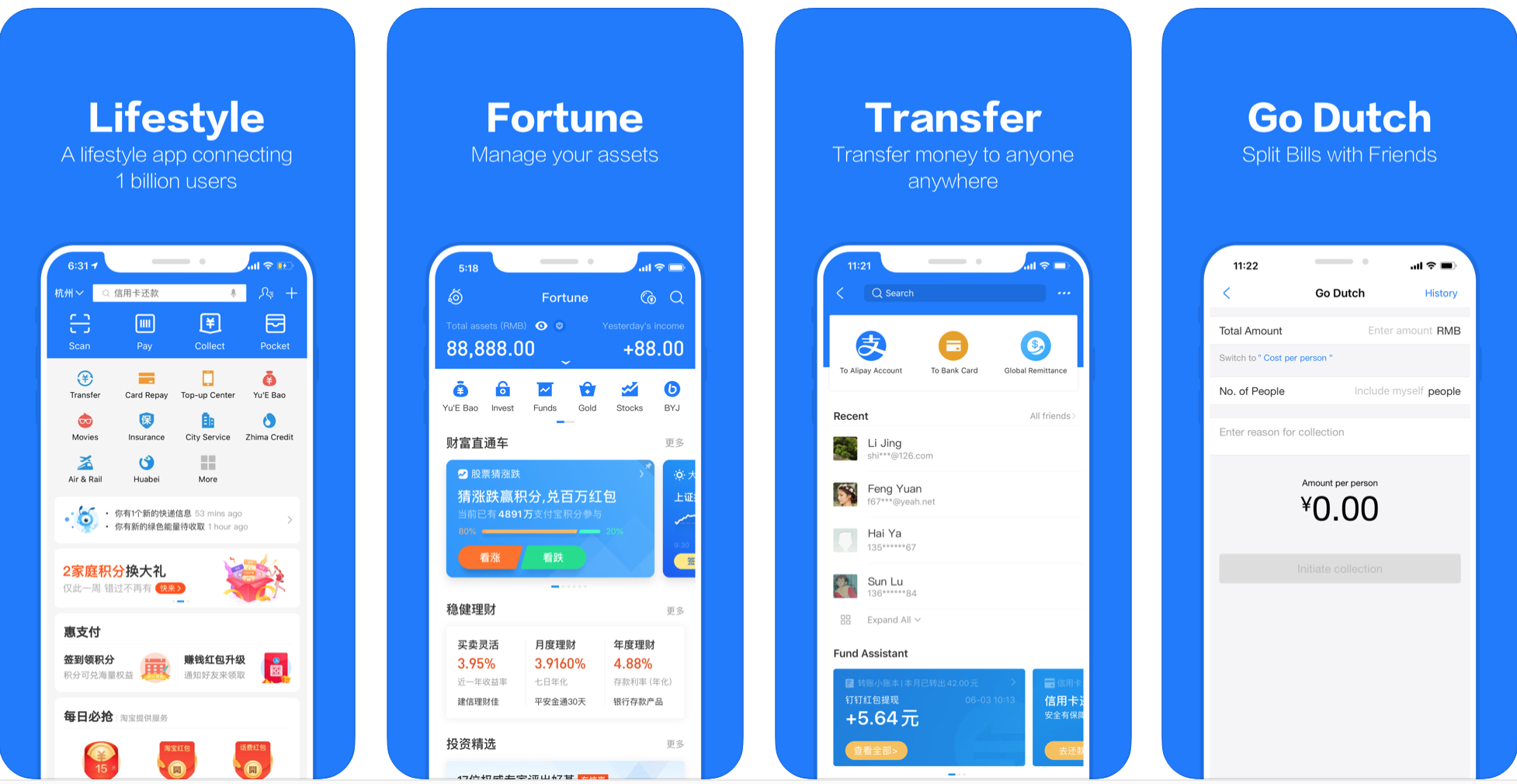
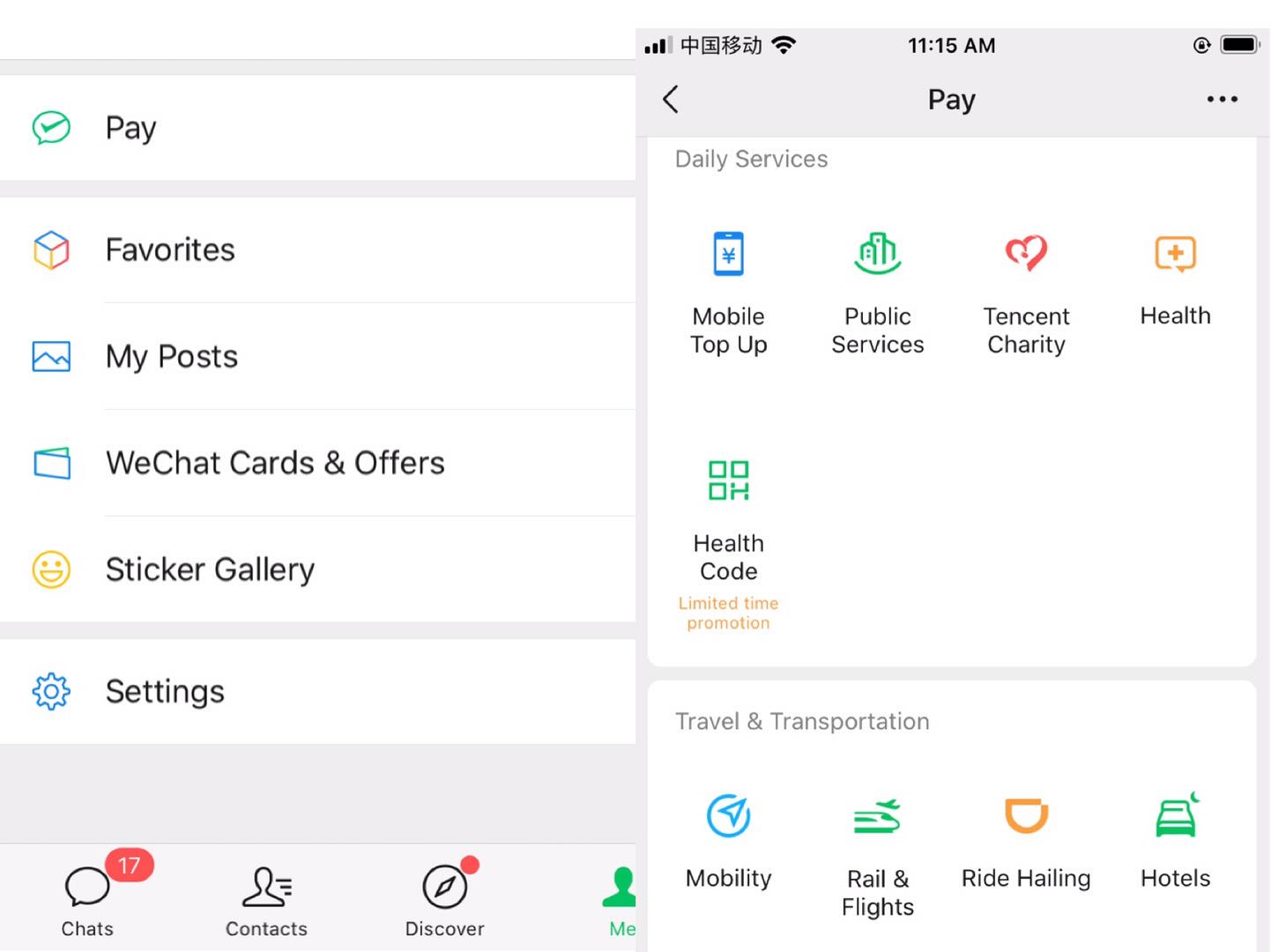
Both companies ventured into fintech by first offering consumers a way to pay digitally, though the brands “Alipay” and “WeChat Pay” fail to reflect the breadth of services touted by the platforms today. Alipay, Ant’s flagship app, is now a comprehensive marketplace selling Ant’s in-house products and myriad third-party ones like micro-loans and insurance. The app, like WeChat Pay, also facilitates a growing list of public services, letting users see their taxes, pay utility bills, book a hospital visit and more.
Tencent, on the other hand, embeds its financial services inside the payment features of WeChat (WeChat Pay) and the giant’s other popular chat app, QQ. It has thus been historically difficult to make out how much Tencent earns from fintech, something the giant doesn’t disclose in its earnings reports. This is reflective of Tencent’s “horse racing” internal competition, in which departments and teams often rival fiercely against each other rather than actively collaborate.
Screenshots of WeChat Pay inside Tencent’s WeChat messenger
As such, we have pulled together estimates of Tencent’s fintech businesses ourselves using a mix of quarterly reports and third-party research — a mark of how un-transparent some of this really is — but it begs some interesting questions. Will (should?) Tencent at some point follow in Alibaba’s footsteps to bring its own fintech operations under one umbrella?
User number
In terms of user size, the rivals are going neck and neck.
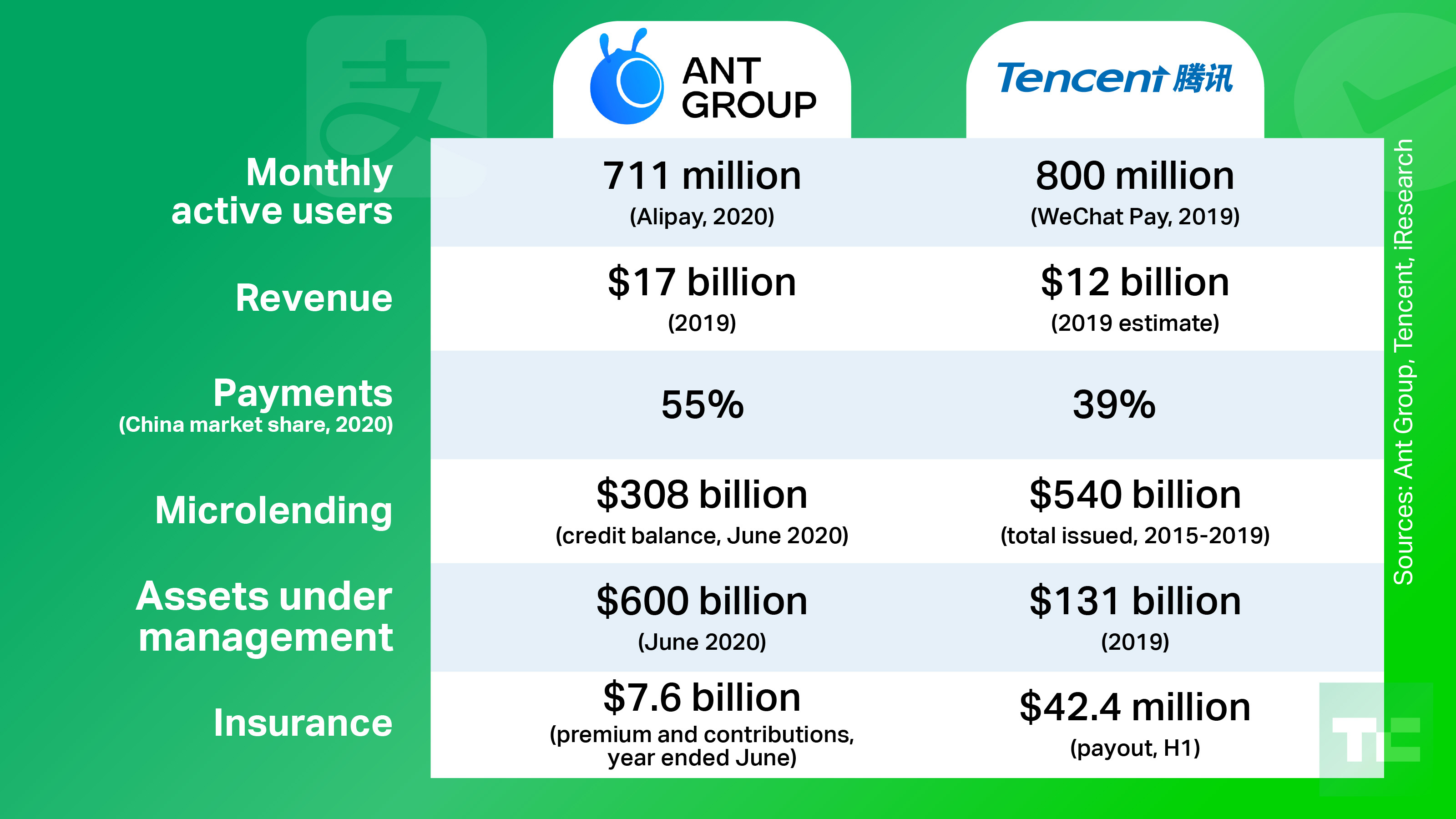
The Alipay app recorded 711 monthly active users and 80 million monthly merchants in June. Among its 1 billion annual users, 729 million had transacted in at least one “financial service” through the platform. As in the PayPal-eBay relationship, Alipay benefits tremendously by being the default payments processor for Alibaba marketplaces like Taobao.
As of 2019, more than 800 million users and 50 million merchants used WeChat to pay monthly, a big chunk of the 1.2 billion active user base of the messenger. It’s unclear how many people tried Tencent’s other fintech products, though the firm did say about 200 million people used its wealth management service in 2019.
Revenue
Ant reported a total of 121 billion yuan or $17 billion in revenue last year, nearly doubling its sum from 2017 and putting it on par with PayPal at $17.8 billion.
In 2019, Tencent generated 101 billion yuan of revenue from its “fintech and business services. The segment mainly consisted of fintech and cloud products, industry analysts told TechCrunch. With its cloud unit finishing the year at 17 billion yuan in revenue, we can venture to estimate that Tencent’s fintech products earned roughly or no more than 84 billion yuan ($12 billion), from the period — paled by Ant’s figure, but not bad for a relative latecomer.
The sheer size of the fintech giants has made them highly attractive targets of regulation. Increasingly, Ant is downplaying its “financial” angle and billing itself as a “technology” ally for traditional institutions rather than a challenger. These days, Alipay relies less on selling proprietary financial products and bills itself as an intermediary helping state banks, wealth managers and insurers to reach customers. In return for facilitating the process, Ant charges administrative fees from transactions on the platform.
Now, let’s turn to the rivals’ four main business focuses: payments, microloans, wealth management and insurance.
Ant vs. Tencent’s fintech businesses. Sources for the figures are companies’ quarterly reports, third-party research and TechCrunch estimates.
Digital payments
In the year ended June, Alipay processed a whopping 118 trillion yuan in payment transactions in China. That’s about $17 trillion and dwarfs the $172 billion that PayPal handled in 2019.
Tencent doesn’t disclose its payments transaction volume, but data from third-party research firms offer a hint of its scale. The industry consensus is that the two collectively control over 90% of China’s trillion-dollar electronic payments market where Alipay enjoys a slight lead.
Alipay processed 55.4% of China’s third-party payments transactions in the first quarter of 2020, according to market research firm iResearch, while another researcher Analysys said the firm’s share was 48.44% in the period. In comparison, Tenpay (the brand assigned to the company-wide infrastructure that powers WeChat Pay and the less-significant QQ Wallet, yet another name to confuse people) trailed behind at 38.8%, per iResearch data, and 34% according to Analysys.
At the end of the day, the two services have distinct user scenarios. The fact that WeChat Pay lies inside a messenger makes it a tool for social, often small, payments, such as splitting bills and exchanging lucky money, a custom in China. Alipay, on the other hand, is associated with online shopping.
That’s changing as Tencent tries to increase its ticket size through alliances. It’s tied WeChat Pay to portfolio e-commerce companies like JD.com, Pinduoduo and Meituan — all Alibaba’s competitors.
Third-party payments were once an incredibly profitable business. Platforms used to be able to hold customer reserve funds from which they generated handsome interests. That lucrative scheme came to a stop when Chinese regulators demanded non-bank payments providers to place 100% of customer deposit funds under a centralized, interest-free account last year. What’s left for payment processors to earn are limited fees charged from merchants.
Payments still account for the bulk of Ant’s revenues — 43%, or a total of 51.9 billion yuan ($7.6 billion) in 2019, but the percentage was down from 55% in 2017, a sign of the giant’s diversifying business.
Microlending
Ant has become the go-to lender for shoppers and small businesses in a country where millions aren’t qualified for bank-issued credit cards. The firm had worked with about 100 banks, doling out 1.7 trillion yuan ($250 billion) of consumer loans and 400 billion yuan ($58 billion) of small business loans in the year ended June. That amounted to 41.9 billion yuan or 34.7% of Ant’s annual revenue.
The size of Tencent’s loan business is harder to gauge. What we do know is that Weilidai, the microloan product sold through WeChat, had issued an aggregate of 3.7 trillion yuan ($540 billion) to 28 million customers between its launch in 2015 and 2019, according to a report from WeBank, the Tencent-backed private bank that provides the WeChat-based loan.
Wealth management
As of June, Ant had 4.1 trillion yuan ($600 billion) assets under management, making it one of the world’s biggest money-market funds. Working with 170 partner asset managers, the segment brought in about 17 billion yuan or 14% of total revenue in 2019.
Tencent said its wealth management platform accumulated assets of over 600 billion yuan in 2018 and grew by 50% year-over-year in 2019. That should put its AUM in 2019 at around 900 billion yuan ($131 billion).
Insurance
Last but not least, both giants have made big pushes into consumer insurance. Besides featuring third-party plans, Alipay introduced a new way to insure customers: mutual aid. The novel scheme, which is not regulated as an insurance product in China, is free to sign up and does not charge any premium or upfront payment. Users pay small monthly fees that are pooled to pay for claims of critical illnesses.
Insurance premiums and mutual aid contributions on Ant’s platform reached 52 billion yuan, or $7.6 billion, in the year ended June. Working with about 90 partner insurers in China, the segment contributed nearly 9 billion yuan, or 7.4%, of the firm’s annual revenue. More than 570 million Alipay users participated in at least one insurance program in the year ended June.
Tencent, on the other hand, taps partners in its relatively uncharted territory. Its insurance strategy includes in-house platform WeSure that works like a middleman between insurers and consumers, and Tencent-backed Waterdrop, which provides both traditional insurances and a rival to Ant’s mutual aid product Xianghubao.
In the first half of 2020, WeSure, Tencent’s main insurance operation that sells through WeChat, paid out a total of 290 million yuan ($42.4 million), it announced. The unit does not disclose its amount of premiums or revenues, but we can find clues in other figures. Twenty-five million people used WeShare services in 2019 and the average premium amount per user was over 1,000 yuan ($151). That is, WeShare generated no more than 25 billion yuan, or $3.78 billion, in premium that year because the user figure also accounts for a good number of premium-free users.
*
Moving forward, it remains unclear whether Tencent will restructure its fintech operations in a more cohesive and collaborative way. As they expand, will investors and regulators demand that? And what opportunities are there for others to compete in a space dominated by two huge players?
One thing is for sure: Tencent will need to tread more carefully on regulatory issues. Ant’s achievement is a win for entrepreneurs looking to “disrupt” China’s financial sector, but its halted IPO, which is tied to regulatory issues and reportedly Jack Ma’s hubris, also sounds an alarm to contenders that policymaking in China can be capricious.
Elon Musk’s tunneling and transportation startup The Boring Company is eyeing Austin for its next project based on several new job postings.
The Boring Company, which last year landed a deal to construct and operate a “people mover” for the Las Vegas Convention Center, tweeted Monday that is was hiring in Austin. Engineering, accountant and business development positions are listed on its website, the type of jobs that suggest that The Boring Company sees enough opportunity in Austin to set up more permanent operations there.
Rumor has it that "Austin Chalk" is geologically one of best soils for tunneling. Want to find out? Austin jobs now available.https://t.co/imlQMDfprJ
Austin is becoming a hotbed of Musk-related activity. Tesla, which Musk leads, picked in July a site near Austin for its next U.S. factory, a four to five-million-square foot $1.1 billion plant that will assemble the automaker’s futuristic Cybertruck, the Tesla Semi and the Model Y and Model 3 for sales to customers on the East Coast.
Musk described the future factory as an “ecological paradise,” with a boardwalk and bike lanes and where the public will be welcome. It’s unclear if the first customer of The Boring Company will be Tesla.
The Boring Company has five product lines, all of which are centered around tunneling. The startup, which raised $120 million in new funding in summer 2019, offers the base tunnel to customers as well as those designed for use by utilities, pedestrians, freight and it’s so-called Loop service.
The company describes the Loop as an underground public transportation system in which passengers are transported via in autonomous vehicles at up to 150 miles per hour through tunnels between stations. The company says the autonomous vehicles are Tesla Model S, 3, and X. (It should be noted that while Tesla vehicles do have robust advanced driver assistance systems, they are not considered by government bodies such as the U.S. DOT as fully autonomous.)
The Loop is what Las Vegas Las Vegas Convention Center officials sprang for. Under its contract, the LVCC Loop is supposed to transport attendees through two 0.8-mile underground tunnels in Tesla vehicles, four or five at a time. Planning files reviewed by TechCrunch seem to show that the Loop system will not be able to move anywhere near the number of people LVCC wants, and that TBC agreed to.
Sony has announced that it is entering the drone market with a new brand called Airpeak, though the specifics of the drone itself are left something of a mystery. It plans to launch the project next spring.
The barebones announcement says only that Sony has been inspired by the “recent proliferation” of drones and the changes they have caused in both the industrial and creative sectors.
Airpeak will focus on multiple industries as well, though it has its work cut out for it if it intends to go up against DJI, which has become the first choice in the consumer UAV sector.
Sony describes the drone as being developed within “the field of AI robotics,” which, along with the aim to enable drone use where it was previously difficult to do so, suggests Sony plans to integrate a fair amount of intelligence into the drones’ systems.
Small UAVs have gotten smarter and smarter, able now to avoid obstacles, recognize other flying objects, and navigate between buildings without any intervention from their human operators. But many of these capabilities are still essentially theoretical rather than widely deployed.
Beyond the name, general flavor of the project, and a render of what is almost certainly a rotor, that is the sum total of what we know about Sony’s new project. Expect more to be posted to the official website in time.
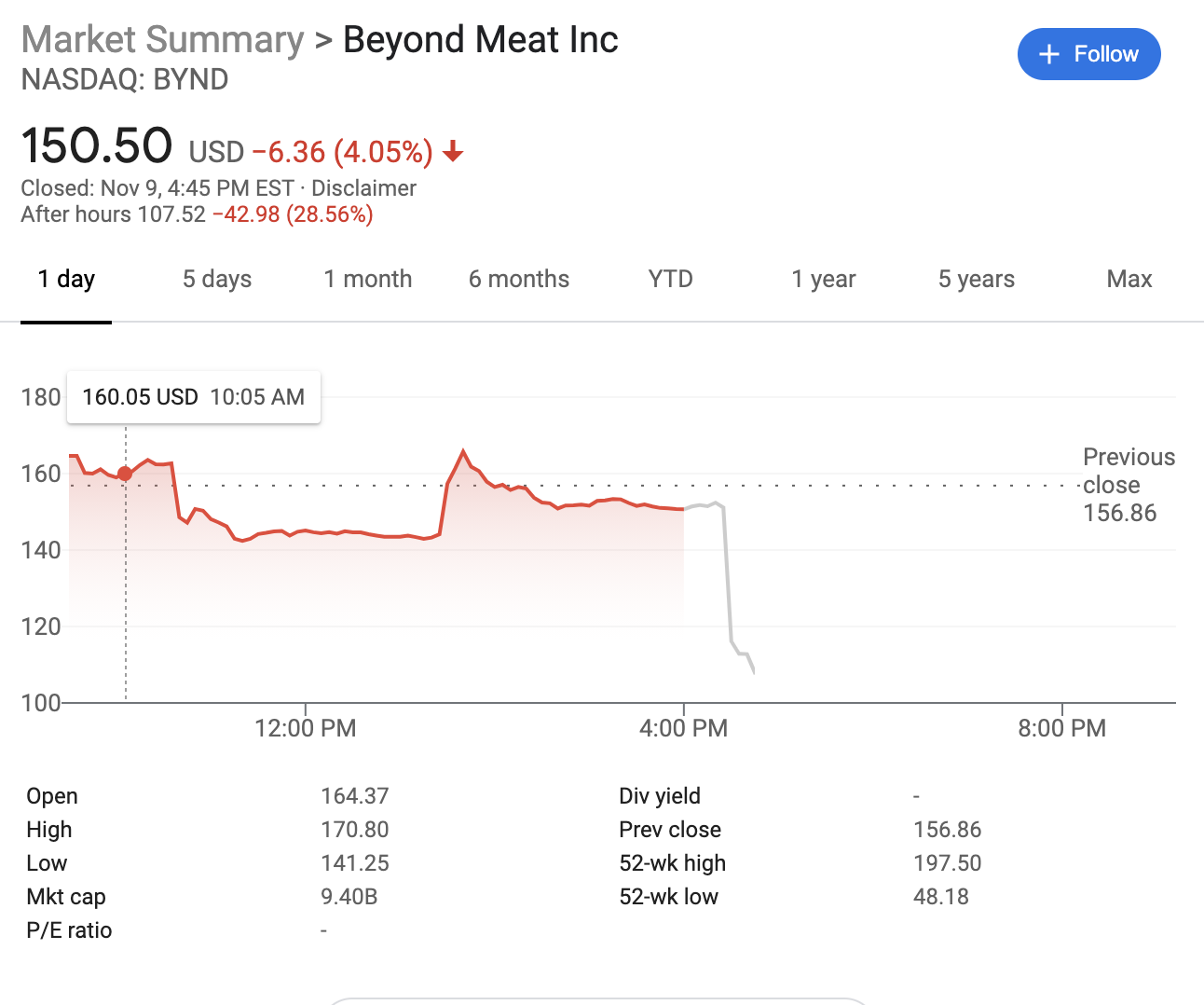
Beyond Meat’s partnership with McDonald’s to develop the McPlant burger wasn’t enough to keep shares from collapsing after the company posted third-quarter earnings that fell far below analysts’ expectations.
The big miss sent shares tumbling nearly 29% in after markets closed Monday after reporting it generated $94.4 million in revenues and a loss of 28 cents per share vs the $132.8 million in revenue and 5 cents per share loss that analysts had expected.
“Our financial results reflect a quarter where for the first time since the pandemic began, we experienced the full brunt and unpredictability of COVID-19 on our net revenues and accordingly, throughout our P&L,” Beyond Meat’s president and chief executive, Ethan Brown, said in a statement. “Unlike the second quarter where record retail buying and freezer loading by consumers offset the deterioration of our foodservice business as COVID-19 stay-at-home and related measures set in, the long tail of retail stockpiling by consumers, coupled with continued challenges across the majority of our foodservice customers, led to Q3 results that were lower than we expected.”
The company reported losses of $19.3 million in the third quarter of 2020 compared to net income of $4.1 million in the year-ago period, according to a statement. Net loss per common share reached 31 cents per-share in the third quarter compared to 6 cents per-share in the year-ago-period.
Despite the poor performance, Beyond Meat is doubling down on its expansion plans by acquiring a new factory in Pennsylvania and its expansion in China and Europe. Brown also pointed to other data that suggests the business is growing.
“Even as the pandemic has created significant disruption, we continue to see strong growth in critically important metrics of household penetration, buyer rates, purchase frequency and repeat rates; our brand’s sales growth continues to outpace the category; and during the quarter we saw our year-over-year velocities rise even as we grew distribution,” he said in a statement.
Beyond Meat’s third-quarter earnings report capped a volatile day for the company that saw its share price seesaw as details of the McDonald’s plant-based burger emerged. Shares of Beyond Meat initially fell after McDonald’s announced that its new plant-based patty and chicken substitute formulation was made in-house. However, McDonald’s overstated its own role in the creation of its McPlant, which was actually developed in conjunction with Beyond Meat, according to a statement provided to CNBC. Beyond Meat shares rebounded only to fall again after the market closed due to its third-quarter earnings.
Brown stuck by McDonald’s despite the restaurant chain’s decision to leave Beyond Meat out of its initial announcement.
“Our relationship with McDonald’s is really good and really strong,” Brown said on an investor call. “I respect their decision to refer to the McPlant platform in the generic sense. We are working with them on a number of matters.”
Inrupt, the startup from World Wide Web founder Tim Berners-Lee, announced an enterprise version of the Solid privacy platform today, which allows large organizations and governments to build applications that put users in control of their data.
Berners-Lee has always believed that the web should be free and open, but large organizations have grown up over the last 20 years that make their money using our data. He wanted to put people back in charge of their data, and the Solid open source project, developed at MIT, was the first step in that process.
Three years ago he launched Inrupt, a startup built on top of the open source project, and hired John Bruce to run the company. The two shared the same vision of shifting data ownership without changing the way websites get developed. With Solid, developers use the same standards and methods of building sites, and these applications will work in any browser. What Solid aims to do is alter the balance of data power and redirect it to the user.
“Fast forward to today, and we’re releasing the first significant technology as the fruits of our labor, which is an enterprise version of Solid to be deployed at scale by large organizations,” Bruce explained.
The core idea behind this approach is that users control their data in online storage entities called Personal Online Data Stores or Pods for short. The enterprise version consists of Solid Server to manage the Pods, and developers can build applications using an SDK to take advantage of the Pods and access the data they need to do a particular job like pay taxes or interact with a healthcare provider. Bruce points out that the enterprise version is fully compatible with the open source Solid project specifications.
The company has been working with some major organizations prior to today’s release including the BBC and National Health Service in the UK and the Government of Flanders in Belgium as they have been working to bring this to market.
To give you a sense of how this works, the National Health Service has been building an application for patients interacting with them, who using Solid can control their health data. “Patients will be able to permit doctors, family or at-home caregivers to read certain data from their Solid Pods, and add caretaking notes or observations that doctors can then read in order to improve patient care,” the company explained.
The difference between this and more conventional web or phone apps is that it is up to the user who can access this information and the application owner has to ask the user for permission and the user has to explicitly grant it and under what conditions.
The startup launched in 2017 and has raised about $20 million so far. Bruce and Berners-Lee understand that for this to take root, it has to be easy to use, be standards-based and and have the capacity to handle massive scale. Anyone can download and use the open source version of Solid, but by having an enterprise version, it gives large organizations like the ones they have been working with the support, security and scale that these companies require.
A former controller and CFO of the state of California, Steve Westly is passionate about government. The onetime eBay exec and early Tesla board member has also been a proponent of clean energy for roughly 30 years, so he’s feeling optimistic right now, with former U.S. VP Joe Biden amassing a growing number of electoral votes and widening his leading Donald Trump as he inches toward an election win.
We talked earlier today with Westly, who founded the venture firm The Westly Group 13 years ago and which is currently raising up to $250 million for a fourth fund, according to SEC paperwork filed earlier this week. We wanted to know whether he thinks Biden will be able to achieve any part of his climate plan in the likely scenario that Republicans continue to control the Senate. We also wondered what he makes of VCs leaving California, and where he sees the most opportunities right now. We kicked off our conversation with the news of the day. Our chat has been edited lightly for length.
TC: As we talk, Joe Biden looks to be on the cusp of winning the U.S. presidential election while Donald Trump continues to tweet about taking his claims about a rigged election to the Supreme Court. Are you concerned about that rhetoric, given that Republicans don’t seem to be pushing back against it?
SW: You have to be worried about such things, but I think most people are looking at the big picture. This is not going to be a 270 to 268 [electoral college] vote. Biden might get 290 to 306 [electoral votes]. It’s a decisive difference. He also received more than 4 million more [popular] votes than Trump. The people have spoken, and they’ve spoken loudly.
There are rules in most states that say if you aren’t within a percent or half a percent — i think [Biden has a] 1.6% [advantage] in Nevada and 1.4% [lead in] Arizona right now — there won’t be a recount. I think his lead in Pennsylvania will rise to 100,000, so the window [for a Trump win] is diminishing pretty quickly.
I am also seeing more Republican officials, like Senator Bob Toomey of Pennsylvania, saying that we count the votes, we follow the rules, what the president is doing is irresponsible, and it’s time to move on.
TC: You’re raising a fund that you’ve already told me you won’t talk about, citing SEC rules, but I’m wondering: has Westly Group’s mandate has changed over time? I remember when the firm was first formed that it was one of the only pure ‘cleantech’ venture firms, but it seems like it has broadened out a bit.
SW: Sustainable energy has become the new hot thing and it makes me laugh because I’ve been involved in energy for 30 years [including in government roles]. I wrote two books on the future of energy in the ‘80s, so I’ve been at this a bit.
Our thesis continues to be that there are revolutions occurring in smart energy, mobility and smart buildings, and they are being driven by renewable energy, which costs less than carbon-based fuels in virtually every part of the world today, from the U.S. to India to Africa. That’s not a political statement; it’s a fact.
Fully 70% of new energy coming online now is sustainable, so people are smart to pay attention to that. Because costs are going down and the cost of storage is going down precipitously — the cost of lithium ion batteries came down so much that we reached an inflection point in 2018, and the cost of a kilowatt per hour costs less than $150 now — everybody is going electric.
Carmakers haven’t wanted to say this publicly because it freaks out shareholders, but we’re headed toward a world where the majority of energy will be sustainable in the near future and most of the cars will be electric and that will happen a lot faster than people think.
Buildings play a key role, too, because they’ve historically been dumb; now they’re digitized buildings with power storage, and soon every home, building, hospital, and university [will run off digitized energy] and you‘ll see arbitrage happening continuously between buildings, homes, and vehicles, where people won’t pay a penny for electricity or gasoline every again. A decade ago when I said this, people thought I was nuts, but now California requires that all newly constructed homes must have solar panels.
TC: With things moving more quickly in that direction, what does all this lost revenue mean for PG&E, the company that powers most of Northern California and whose infrastructure is already crumbling and causing wildfires?
They should follow the lead of smart utilities like Duke [a Westly Group investor] and European companies that are moving beyond traditional revenue streams to new revenue streams. Every utility today has a menu, and if yours only features electricity ions and gas molecules, that’s not a good menu. It’s like saying we have soup and meat, period. These companies should have a special menu for residential customers and a different menu for commercial and industrial customers and they should be thinking about installing power walls and putting solar on roofs; they should be thinking long-term contracts, like even financing electric vehicles.
TC: PG&E is in a bad spot, but California may be, too, as a lot of people leave the Bay Area, citing taxes, among other reasons. Are you worried about a broader movement out of the state and what it could mean?
SW: This is the big question of the next 10 years. California is about to face a wall of debt. We’ve gone from a surplus to what could be a $40 billion deficit in a very short period [because of COVID-19].
This year will be covered a little because there’s still an active IPO market [as capital gains are taxed the same as income, making the state heavily dependent on the stock market]. But there are 12.6 million Americans out of work, and a disproportionate number of them are in California, so likely a Democrat-controlled legislature will try and start to pass a series of taxes.
Prop 15 [which would have taxed properties based on their current market value rather than purchase price and would have increased property taxes on commercial properties] failed, so this will be an ongoing issue. Still, if we continue to raise taxes, we run the risk of losing entrepreneurs to other states. I know firsthand many friends who have moved to Austin. We need to have a balanced approach to managing out expenses without pushing people off to other states.
TC: Any bright ideas on that front?
SW: I was the CFO of California, and your option beside taxing more is spending less. Those are the choices.
Longer term, we need a major overhaul of the tax system so we aren’t aren’t so dependent on capital gains, which is a roller coaster system where when you hit a trough in the market, you have to go and lay off a bunch of teachers, then try to hire them back when the economy is better.
TC: It’s looking like Joe Biden is going to win the election, but there’s also a strong chance that he’ll be working with a Republican-controlled Senate. Meanwhile, climate change was not in the top five concerns for voters of either party. Does this can get kicked down the road again?
No, it just means they’ll have to work together and that he’ll have to go directly to the issues that are most popular to get them through.
Trump had no clue that sustainable energy is immensely popular today and that some of the states that used to block green initiatives — including Texas, North Dakota, and South Dakota — are increasingly becoming wind and solar powers, such that their senators who used to say, ‘natural gas forever’ are also saying that solar and wind are employing more and more people in their states.
What do you see as first steps?
SW: Biden will bring the U.S. back into the Paris climate agreement. You’ll also see him at the front of this global movement toward the electrification of everything, and there will be support for EVs and support for sustainable energy.
You’ll also see some sort of penalties or restrictions on carbon-based fuels because of the increased data we have that carbon in the atmosphere is causing public health problems, reducing air quality and that large insurance companies are having to pay for [these things]. Now that Munich Re and others say, ‘We pretty much know what the cost is, and we’re charging you back,’ the government can use that data to charge carbon producers appropriately.
TC: Traditional energy companies– the biggest carbon emitters — say they’ve resolved to address this problem. Do you think that’s mostly optics?
SW: A lot is optics, but it’s also a realization that you either change your business model or you go down with the ship. You don’t want to take the Kodak approach. You want to be Apple and reinvent yourself.