Amazon UK

Showing posts with label Blog – Neil Patel. Show all posts

Tuesday, 10 November 2020

How to Write Emails That Actually Drive Results

How to write email for customers, How to Write Killer Emails That Actually Drive Results

Every client that I work with has his or her own unique problems, but they all have one thing in common.

Can you guess what it is?

Regardless of industry, size, or even the person’s position within the company, everyone uses email and wants to know how to write email that customers open.

Despite the rise of social media, forums, and mobile chat apps, email remains one of the most popular forms of communication in the world.

According to a study from Radicati, there are over 3.7 billion email users worldwide, and that number is steadily rising.

Worldwide Email Usage Stats

If you think that statistic is high, you’ll want to sit down before I tell you the volume of emails being sent.

We’re sending and receiving 269 billion emails every day. It seems impossible to stick out in this crowd.

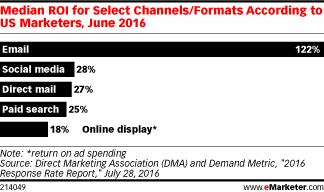
Yet email remains one of the most effective channels of marketing, with a median ROI that’s nearly 5x that of other channels like social media, direct mail, and paid search.
How to Write Emails That Actually Drive Results

Adobe even found that half of all consumers prefer being contacted by brands via email over social media and direct mail.

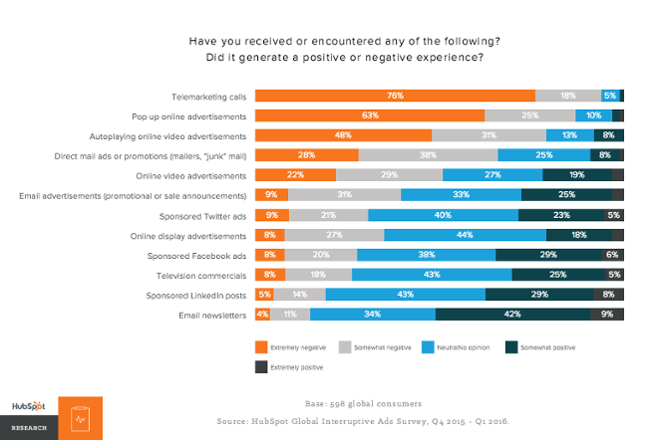
Email newsletters specifically have the highest reported positive experience by consumers in a recent survey.
How to Write Emails That Actually Drive Results

Of course, knowing email is effective and writing an effective email doesn’t necessarily go hand-in-hand.

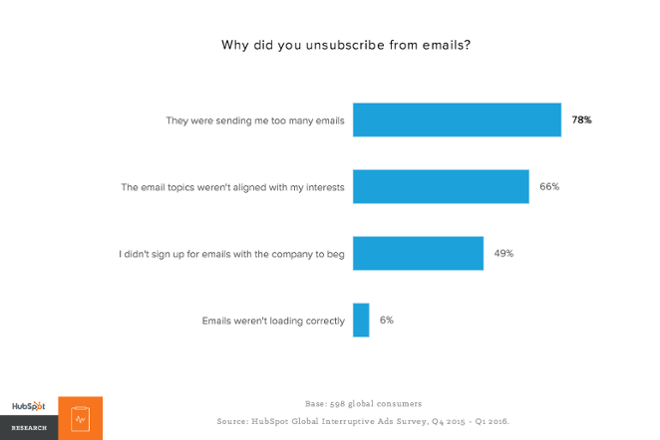
If you send the wrong emails, you’ll end up losing customers. In fact, 66% of people unsubscribe from emails because they’re not aligned with their interests.
page13.pngt1500352820125width660namepage13

You need great emails to keep your customers happy.

That’s the problem I’m going to alleviate for you today.

You know all the reasons why you should be using email, but we’re going to dive into the nitty-gritty details of how to actually write these emails.

The first step is to segment our email lists so we can target our emails to the right audiences.

How to Write Emails With Proper Audience Segmentation

We know email is effective, but we don’t have time to personally email each and every customer on our lists. Each email needs to feel personal, though.

When your customers are properly segmented, it’s easier to send emails that feel more personalized.

Messages will be based on your target customers’ interactions with your company and website. As a result, they won’t feel generic, sporadic, or irrelevant.

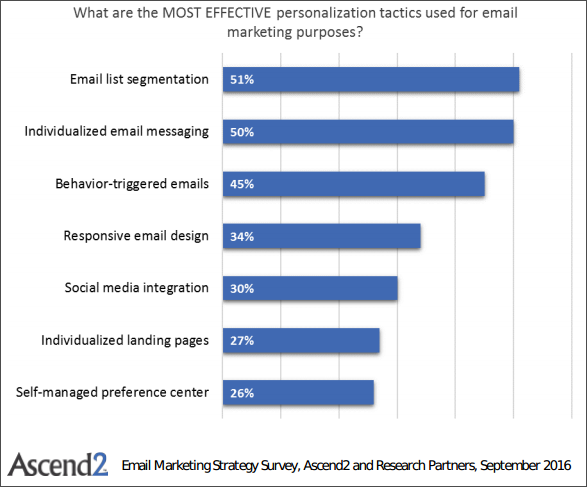
A recent survey by Ascend2 found that 51% of marketers consider email list segmentation to be the most effective personalization tactic.
list segmentation

Did a customer recently make a purchase from you?

A thank-you email explaining the benefits of the purchase can help you keep your brand front-and-center in that customer’s mind.

Perhaps a prospective customer abandoned his or her shopping cart before taking the next step and purchasing a product. Consider sending a discount code to entice that person back.

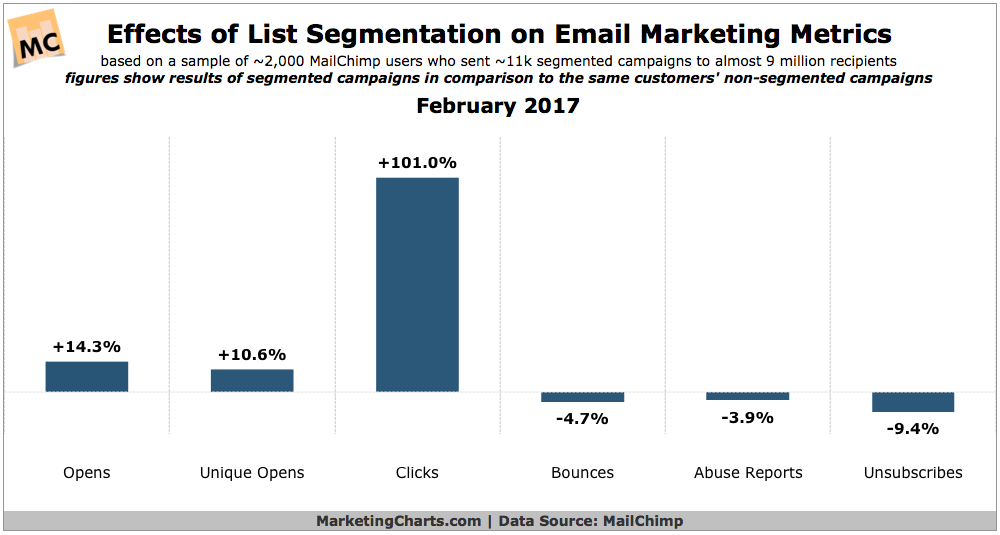
MailChimp recently measured 11,000 segmented campaigns against non-segmented campaigns from the same customers. It found that the segmented campaigns outperformed their non-segmented counterparts across every metric.
Statistics about list segementation email marketing

So what are some ways to segment your customer lists?

Basic demographics like age, sex, and location are a great place to start. They’re not always enough, but they’ll help you get started.

You’re likely going to speak differently to a retired veteran than you would to a teenager or recent college grad. Also, men and women may respond differently to the language you use in email marketing.

Of course, this type of personal information may not be available. It’s also not the most effective way to segment audiences.

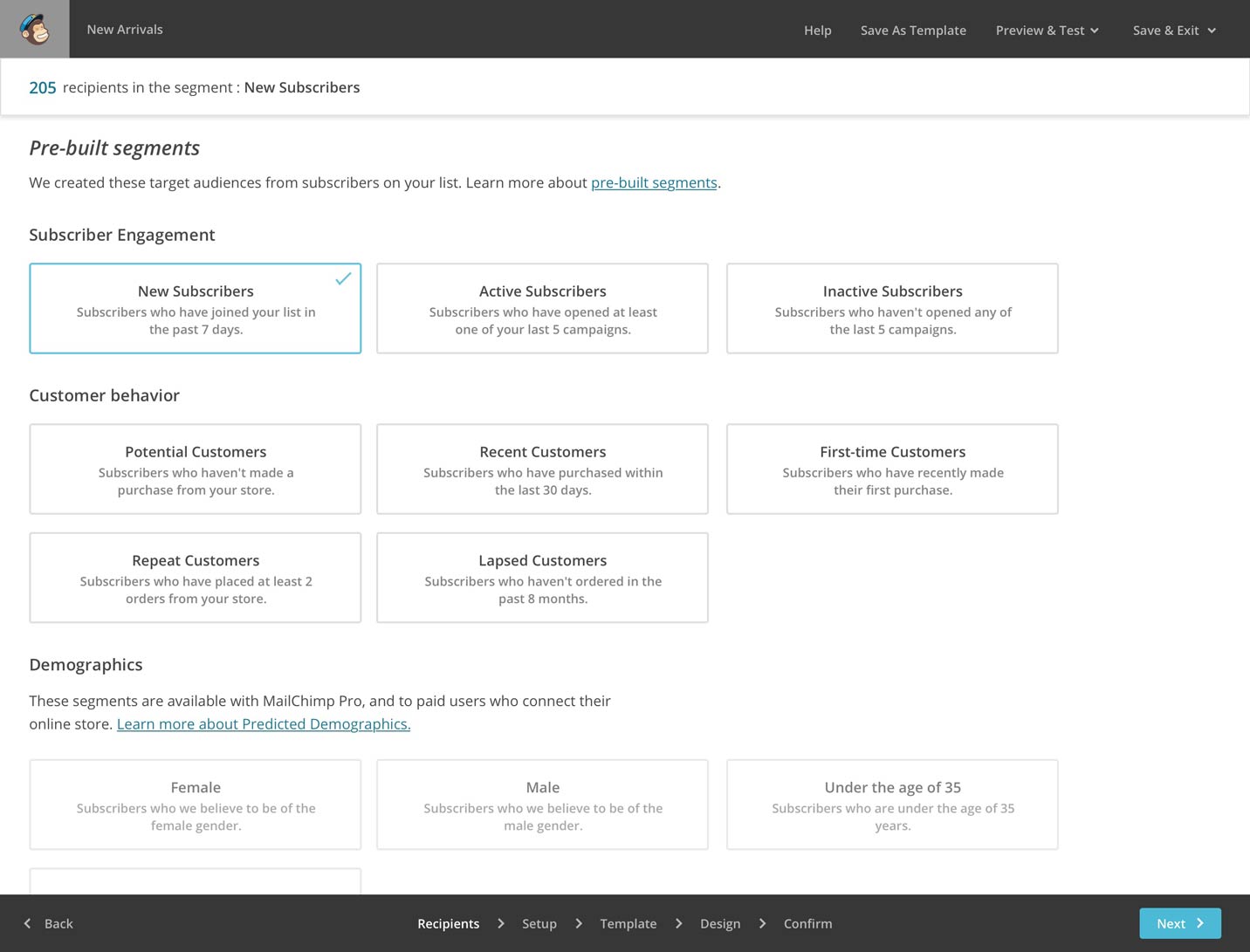
Marketing automation platform MailChimp offers a variety of popular audience segmentation options based on engagement, behavior, and other criteria that you might find useful.
prebuilt segments 285211ed

These behavioral triggers are actually much more likely to predict a customer’s response anyway. Recommended purchases, for example, work regardless of age, sex, or location.

Behaviors like buying, canceling, subscribing, and cart abandonment can be easily addressed with personalized emails.

Ideally, you’ll send the right message to the right consumer at the right time. It sounds impossible, but modern marketing technology makes it not only accessible, but also automated.
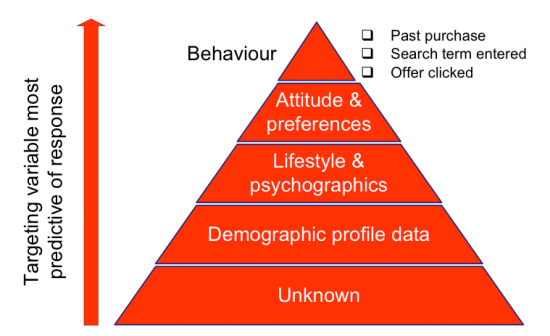
5 targeting options | How to write emails

Behavior triggers stand out as one of the most effective innovation opportunities for markers. Marketers can analyze behavior triggers among their audiences to find strategies that really work.

If you can set up an email marketing strategy that actually makes consumers eager to open your emails, you stand to enjoy much greater conversion rates.
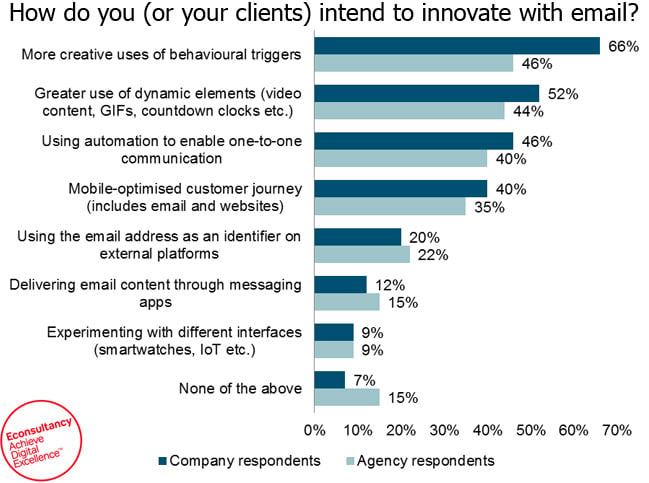
email innovation future of email | how to write emails

As mentioned above, behavior segmentation also makes it easier to automate emails.

Marketing automation is an important part of the sales cycle, and you’re essentially leaving money on the table by not employing it.

Don’t miss out on this opportunity!

Charity: Water, for example, has a great email automation campaign that tracks the progress of your donation to the organization.
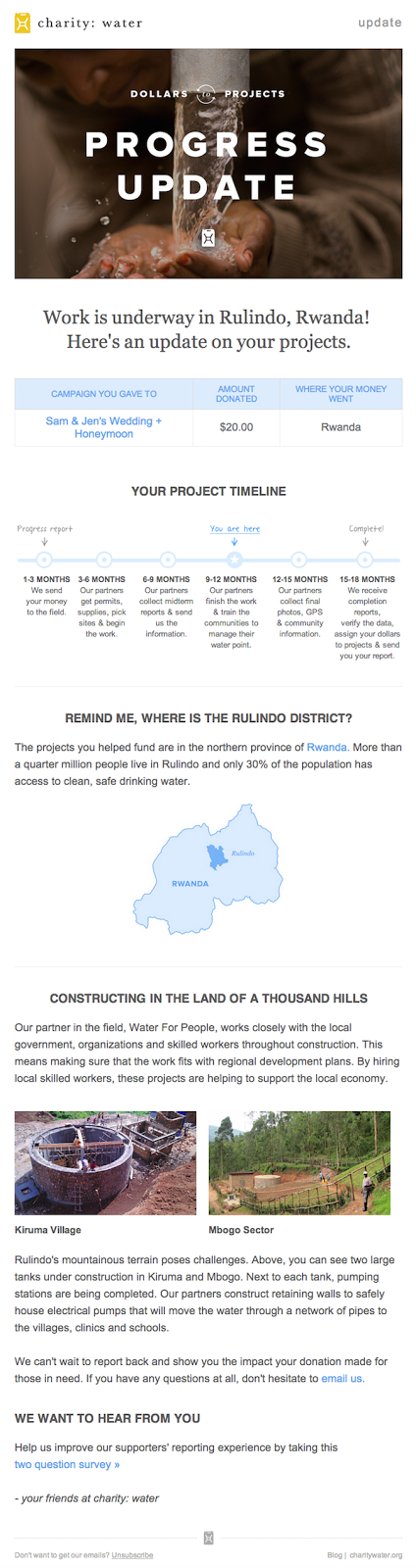
charity water email example 1.pngnoresizet1500337379701width669namecharity water email example 1

When we donate money, we rarely get to see how the money is being spent. In fact, it’s one of the key barriers that nonprofits face when attempting to raise funds.

Automated emails that provide useful data provide personalized transparency to the process. Consumers feel like they understand their role in the equation.

Now we have our customer lists segmented into the right groups, and it’s time to craft the right emails for each group.

To do that, we need to decide what our goal for each segment is and work backward from there.

How to Write Email by Building Backward From the Goal

It’s important to have a goal for your email campaign. Otherwise, you’re just firing off emails and hoping to resonate with your audience.

Not a good strategy.

There are only four basic types of emails you can write:

  • Narrative: Tell a compelling story.
  • Descriptive: Illustrate your product or service with words.
  • Expository: Teach your audience how to do something.
  • Persuasive: Convince readers to take action.

Each type will have a different tone and goal.

Let’s say your goal is to persuade customers to complete a post-purchase survey about their experience.

There needs to be a clear CTA, preferably graphic, that entices users to click. That should be the focus of a short email that concisely explains the benefit of taking the survey.

Here’s an example of a persuasive email from Wayfair.
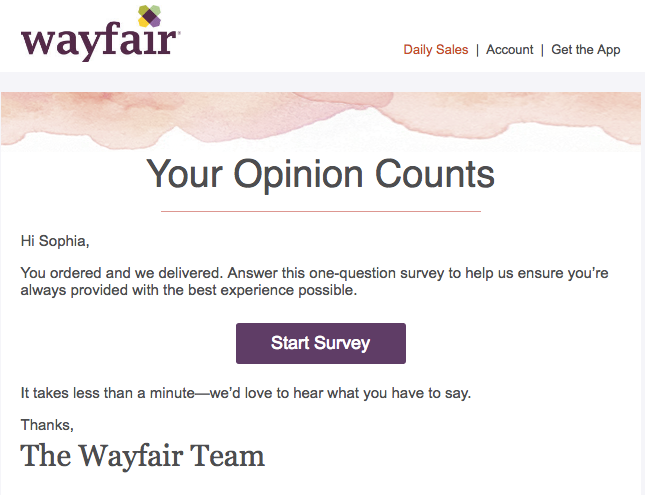
How to write email for customers wayfair

On the other hand, an expository email provides all the facts necessary for a customer to understand a topic.

These are typically newsletters, but not always.

In the case of this GrubHub email, the goal is an order confirmation displaying all the relevant information about your order.
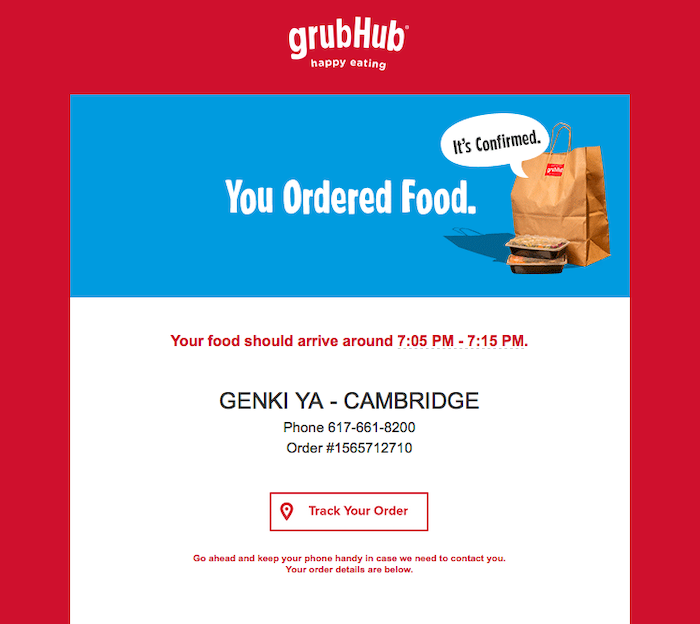
How to write email for customers grubhub

Descriptive emails are typically announcements for new products. They allow you to generate buzz (and hopefully a few sales). Here’s a descriptive menu from Cook Smarts.

Plus, descriptive emails give you a chance to show your passion for your products. Here’s a descriptive menu from Cook Smarts.

cooksmart email example | How to write email for customers

And finally, we have the narrative email, which allows you to tell your brand story. Here, Poncho turns an ordinary weather report into a narrative infographic.

poncho email example | How to write email for customers

Right now we’re going to try an exercise. Think of all the different types of emails you may send to your customers based on their behaviors and other events.

New product releases, leadership changes, sales and promotions, thank-you emails for customers’ order, emails that tell customers you’re sorry to see them go, responses to abandoned carts, and holiday celebrations immediately come to mind.

The next step is to decide the goal for each of these behaviors. What do you want the customer to do?

You typically want a click-through to your website. You can also use a CTA to ask for a purchase or to deliver relevant content.

Creating these templates in advance keeps customers feeling personally connected to your business while you save time and resources.

5 Steps to Write the Perfect Email

Now you know why you should be emailing your customers. You’re also familiar with the different types of emails you might send.

What we need to do is nail down a replicable process for writing them.

Of course, you must start with a list of subscribers. Collect email addresses from your fans and followers so you’re communicating with as many people as possible.

Once you have a list, you can write emails that respond to the behavioral triggers I talked about above.

Here’s where to start.

1. How to Write Email Subject Lines

You only get one chance to make a first impression, and the subject line is that chance for emails.

The subject line determines whether or not your email is ever read. A recent survey found that 33% of email recipients open an email based on the subject line alone.

You have to nail that first impression if you want your copy to get read.

The email marketing specialists at Constant Contact have seen thousands of effective emails. The company offers a few tips for subject lines (along with great examples of winning formulas).

Bisque Imports example | How to write email for customers

It’s important to keep the subject short and snappy. Many email programs cut off long subject lines, which means your subscribers won’t see the whole thing. Above, there’s an example with just a simple acronym from Bisque Imports.

Everyone knows what TGIF means, so it works. However, you can also use other types of language to get your emails read.

A teaser or announcement can provide a great way to entice people to click through and read. People love a mystery or an opportunity, so they’re more likely to check out the email’s body if the subject line arouses their interest.

Check out this example from FluentCity announcing the winners of a recent contest.

Fluent City email 600x350 | How to write email for customers

Whatever you do, avoid spammy language like “Buy Now.”

You don’t need to be overly promotional. Focus on being informative and entertaining.

In fact, entertaining and/or funny subject lines are a great way to increase the chances of an email being opened.

Check out this gem of a subject line from The Basketry.

The Basketry email | How to write email for customers

Nice pun, right?

Once you have the right subject, it’s time to move on to the content of the email body.

2. Keep Emails For Customers Short and Friendly.

The worst mistake you can make with an email is trying to cram too much information into an email. The document ends up being too long.

Sure, people need to know relevant information, but you can spread out the information over several emails.

Alternatively, you can link to pages on your website so the reader can seek out more details if he or she wants.

Whatever the case, don’t waste your subscribers’ time. That’s the fastest way to the “unsubscribe” button.

A simple teaser with a link to your website is all that’s needed.

Check out this simple example from Postmates, which invites customers to click through for a limited-time offer of lattes on demand.
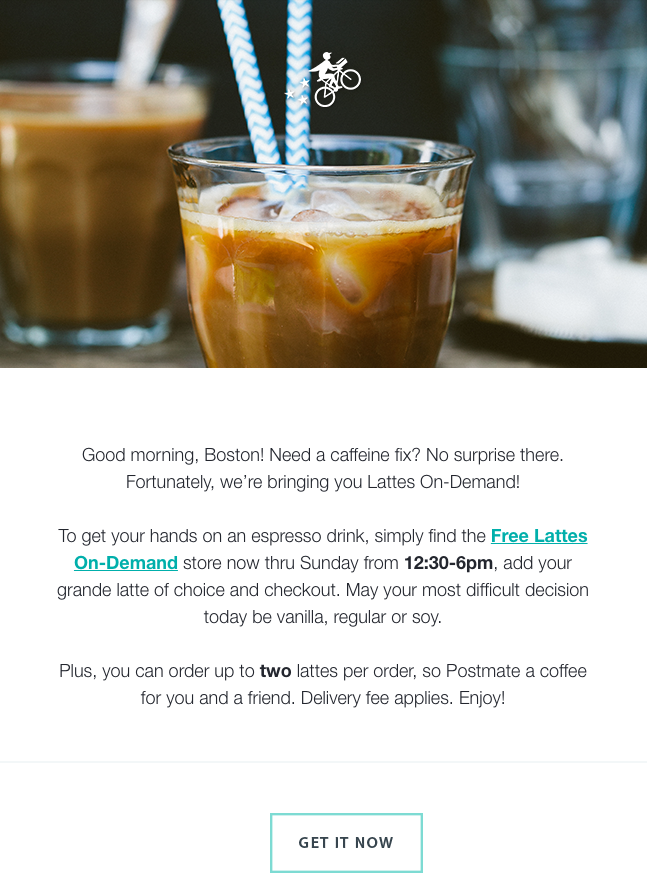
free lattes concise email language example | How to write email for customers

The company doesn’t waste any time getting to the point. There’s a brief, three-word greeting, and then the company immediately jumps into the point of the offer.

After we get a description of the offer, we’re immediately given a CTA button to click through and take advantage of the offer.

This short, sweet, and to-the-point approach is how every email should be treated. We only spend 15-20 seconds reading an email, so it shouldn’t resemble a novel.

There’s a lot of information to fit in such a small space, though, so how do we decide what to cut and what to keep?

Let’s explore that.

3. Write Better Emails by Adding Relevant Information and Calls to Action.

Journalists are required to find out the who, what, when, where, why, and how of a story before publishing. That’s a standard we’re going to set for our emails.

Each email we send needs to answer these vital questions.

Say we have a weekend sale coming up.

The sale is the what, our store location is the where, our business is the who, the holiday is when, special pricing is why, and showing up is how it’s done.

Without this information, your recipients will be lost.

It’s also vital to have a CTA or buy it now buttons. Otherwise, how can your customers take action?

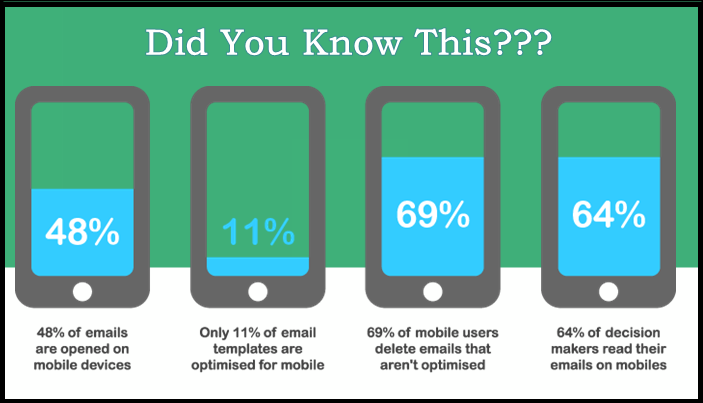
These buttons offer great ways to entice clicks, but before using these advanced techniques, make sure your customers can view them on mobile devices.

Nearly half of emails are checked on mobile devices.

It’s a shame to spend time crafting a brief, compelling email only to experience limited engagement because of mobile incompatibility.

Don’t become that marketer.
pasted image 0 489

Now we need to make sure each customer feels individually connected to your business.

4. Personalize each email and use the second-person point of view.

Nobody wants to feel like they’re just another faceless number.

It’s important to greet each individual using personal language, which becomes an easy feat to accomplish with email template programs.

You also need to write emails in the second person. Focusing on “you” opens a conversation in which the recipient feels important.

Check out this email from The Skimm, which does a great job of using the second person in a personalized email
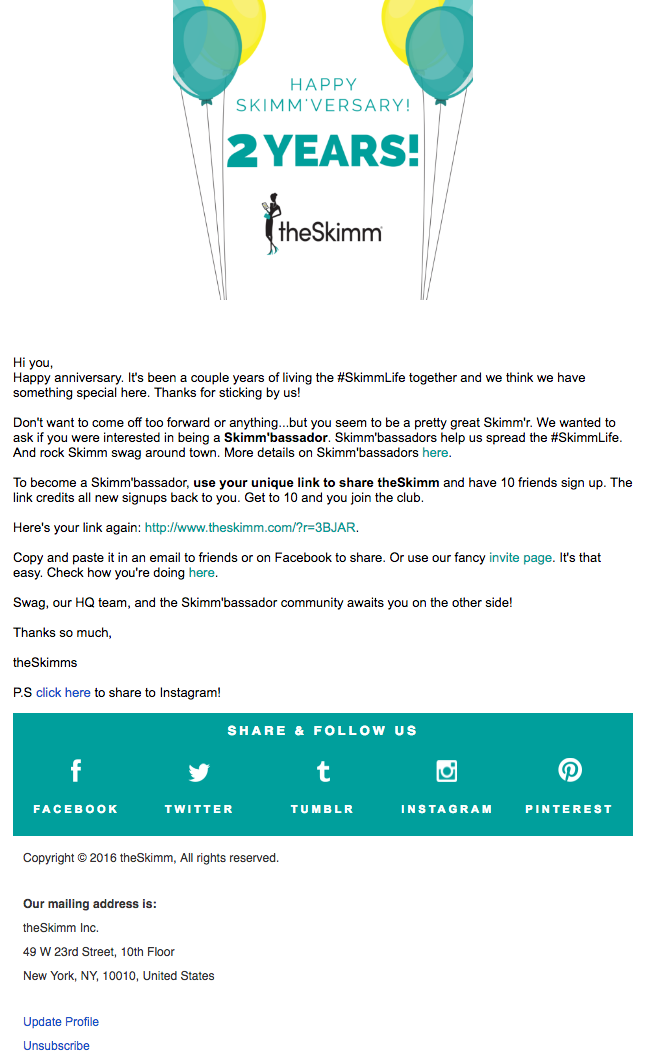
the skimm email example | How to write email for customers

This email makes it clear that the recipient is the center of attention. We all like to feel special, and this is how it’s done.

Now that we have the email together, there’s just one last thing to do.

5. Proofread and check your grammar multiple times.

There’s no worse feeling than spending hours designing the perfect email template, sending it out to your contact list, and finding a glaring typographical error.

Typos are the worst, and with emails, they can constitute a sign of spam. It looks unprofessional and may even get your email blocked by spam filters.

Take the time to perform at least two rounds of edits to check for these typos and to make sure everything is polished before you send an email out to your customers.

Now that everything’s grammatically correct, we can finally send our email out and reap the benefits.

Conclusion

Email is one of the most widely-used forms of communication in the modern world. More people use email than social media, chat programs, and forums.

In other words, it’s the perfect chance to connect with your audience. But only if you follow best practices and get creative.

Sending email newsletters and emails based on triggered actions can increase conversions, build trust, and lead to a healthy ROI.

By creating targeted email templates based on behaviors may be the most important change you make to your digital marketing efforts.

Have you found success using email?

The post How to Write Emails That Actually Drive Results appeared first on Neil Patel.


from Blog – Neil Patel https://ift.tt/2tQSEqd
via IFTTT

Wednesday, 4 November 2020

Best VPS Hosting Plans

Disclosure: This content is reader-supported, which means if you click on some of our links that we may earn a commission.

In a world filled with different web hosting options, VPS hosting has become a popular choice for websites in various categories.

Upgrading to a virtual private server (VPS for short) will drastically improve your site performance if you’re currently on a shared hosting plan. 

For those of you who are starting a new site from scratch and expecting tons of traffic from the beginning, getting a VPS hosting plan out of the gate is a viable option as well. 

There are literally hundreds of thousands of web hosting providers on the market today. That’s why finding the right web hosting plan for your site can be such a tough decision. Fortunately, you’ve come to the right place—this guide will provide you with everything you need to know about VPS hosting.  

The Top 8 Options For VPS Web Hosting

  1. HostGator
  2. InMotion
  3. GoDaddy
  4. Media Temple
  5. InterServer
  6. Liquid Web
  7. Bluehost
  8. Hostinger

How to Choose the Best VPS Hosting Plan For You

As previously stated, the list of web hosting providers is seemingly a mile long. But in terms of actual contenders, there are a couple dozen at most. When it comes to VPS hosting, specifically, the list is even shorter.

But as you’re shopping around and evaluating different VPS hosting providers, these are the factors that you’ve got to take into consideration:

Site Performance Metrics

Site performance needs to be the top priority for everyone seeking a VPS plan. The term “performance” can be pretty subjective, but there are two metrics that matter the most:

  1. Uptime
  2. Speed

Most people searching for a VPS are upgrading from a shared hosting plan that they’ve outgrown. Uptime and speed are the first two things to be affected when you’re sharing server resources with other sites.

You want to make sure that your VPS plan can accommodate your traffic needs. If performance is affected at scale, then you need to look elsewhere. Lots of web hosting providers will give you a guaranteed uptime rate. However, those offers typically come with some contingencies (like planned outages). 

Some sites can’t afford any downtime or slow loading times. If you fall into that category, make sure you get a premium VPS plan. For those of you who would rather save some money, just know that your site performance might be affected.

Dedicated Resources

Technically speaking, you’re still sharing server resources with other websites on a VPS hosting plan. However, the number of sites on the same main server is much lower compared to shared hosting. Plus, each virtual server will have its own dedicated resources.

As you’re evaluating plans, consider the following:

  • RAM
  • Storage
  • Bandwidth
  • CPUs

These resources will have a direct impact on your site speed and uptime (mentioned previously). If you’re maxing out your resources, you can’t expect your site to run at peak performance. 

Optional Root Access

Not everyone needs root access. This feature only really matters if you’re a developer or need the ability to make custom changes to your virtual server at an advanced level.

If that’s the case, then you should be looking for a self-managed VPS plan. Most people will be better off with a fully managed plan (no need for root access here). It’s also worth noting that you can find fully managed VPS plans with optional root access, but that feature won’t really be utilized by the average user. 

Operating System

On the technical side, there are two main options for VPS hosting—Windows VPS and Linux VPS. 

A Windows-based platform will provide you with access levels and performance that’s similar to a dedicated server. If you’re on a self-managed plan, you would be able to install common windows databases and applications like Microsoft SQL, ASP, SharePoint, and ASP.NET.

With a Linux VPS, your virtual servers will support web features like PHP, MySQL, and POP3. Since Linux is an open-source OS, these hosting plans are usually more cost-effective. You could eventually convert your Linux server into a Windows server, but doing the opposite would be much more complex. 

Customer Service

Customer support piggybacks on our last point, especially true if you’re on a fully managed plan. 

You want to make sure that your web hosting provider has your back. What happens if something goes wrong? Who do you contact if you have a problem or question? How do you resolve a time-sensitive issue?

If your site crashes at 10:00 PM on Friday night, waiting to contact a customer support representative at 9:00 AM Monday morning isn’t going to cut it. Look for a VPS provider with 24/7/365 support via phone and live chat. 

Features like free migrations from another provider or hosting type to your new VPS plan would also fall into the support category. Some hosting providers are undoubtedly better than others when it comes to customer service. 

Budget

The price for VPS web hosting varies significantly from provider to provider and plan to plan. We’ve seen VPS hosting plans starting as low as $6 per month. Other plans start at $250+ per month. Most of you will likely fall somewhere between these two extremes. 

In many cases, you can expect to get what you pay for.

If you’re signing up for the cheapest VPS hosting plan that you can find, don’t expect to have extremely high uptime rates and fast page loading speeds. For those of you who want as many dedicated resources as possible, just know that they come at higher price points. 

So you’ll have to weigh your performance and resource needs against your budget.

The Different Types of VPS Web Hosting

There are essentially two different types of VPS hosting—managed and unmanaged plans. I’ll explain the differences between these choices below, and I’ll also provide you with more information on alternative options for web hosting (to make sure a VPS plan is right for you).

Managed VPS

If you’re not very technically inclined and don’t have a dedicated IT team, a managed VPS plan is definitely the best option for you. In short, you won’t have to really handle anything on your own. You’ll be able to just focus on running your website while the hosting provider takes care of the server behind the scenes. 

Here are a handful of examples of what most VPS hosting providers will do for you on a fully managed plan:

  • Set up the server from the start
  • Install your control panel, applications, and OS
  • Handle all application updates and OS updates
  • Server monitoring and maintenance
  • Automated backups
  • Security patches

Some providers will offer a little more or maybe even a little less, but this is generally what you should expect if you choose this type of VPS plan.

Unmanaged VPS

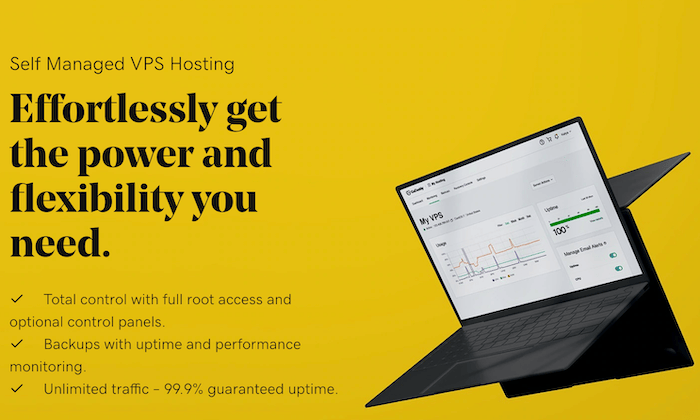
An unmanaged, or self-managed VPS, is just the opposite of a managed plan. You’ll be completely on your own when it comes to installing your software, control panel, security, maintenance, updates, and everything else listed above.

If you experience a hardware failure or an outage, don’t expect a ton of support from your hosting provider either. This type of VPS plan is really intended for those of you who need complete customization at the server level. 

Self-managed plans are usually cheaper as well since the hosting provider doesn’t have to do nearly as much. 

Other Types of Web Hosting

VPS hosting isn’t for everyone. So if you’re new to the world of web hosting, I want to quickly take a moment to explain your other options.

  • Shared Hosting — Shared web hosting is the best option for new websites that aren’t expecting a ton of traffic. You’ll be sharing resources with other sites on the same server. These plans are cheap, but performance can be an issue. If another site on your shared server has a traffic spike and uses up the shared resources, it can impact the uptime and loading speeds on your site. 
  • Cloud Hosting — Cloud hosting is pretty similar to VPS hosting. Think of this as a hybrid version of a virtual private server. Cloud plans come with several remote servers, each one with different responsibilities. If something goes wrong with one of those servers, the others will pick up the slack and keep your site running smoothly. Cloud hosting is generally cheaper than VPS hosting, and it’s easier to scale resources on-demand. However, customization is limited with cloud plans.
  • Dedicated Hosting — Dedicated hosting is the top of the line in the world of web hosting. It’s designed for large sites with tons of traffic. As the name implies, you’ll have one server completely dedicated to your website. This also gives you ultimate control in terms of customizations at the server level. Dedicated hosting comes at a higher price point, but the performance is second to none. 

With all of this in mind, let’s dive into the top VPS hosting plans on the market today:

#1 – HostGator Review — The Best For Reliable VPS Hosting

HostGator has been around for roughly two decades. The hosting provider powers 2+ million websites worldwide.

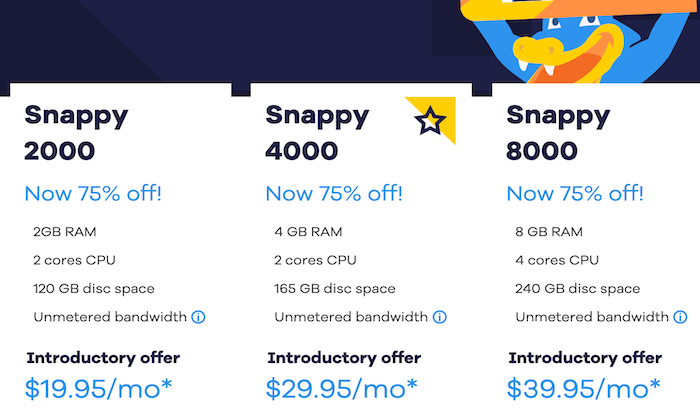
As one of the most trusted names in the web hosting industry, you really can’t go wrong with a HostGator VPS plan. Here’s a look at the different plans and price points:

The VPS hosting plans from HostGator come with full root access and dedicated resources. You’ll also benefit from features like:

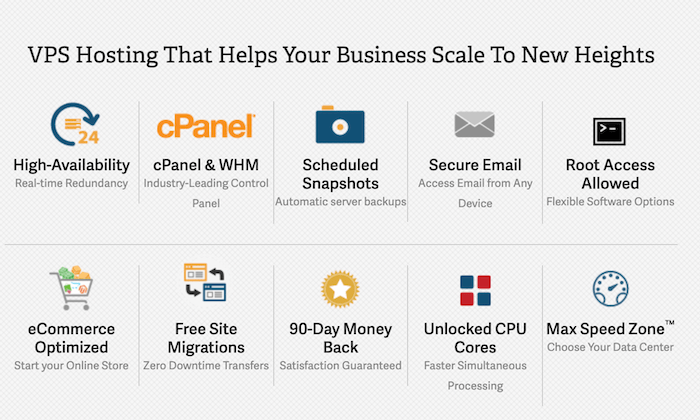
  • Complete customization and total control of your virtual server
  • Free off-site backups of your server data every week
  • Script installers, site templates, and development tools
  • Unlimited domains, databases, email addresses, and FTP accounts
  • Ability to scale CPUs, RAM, and disk space
  • Exceptional customer support, 24/7/365

In addition to traditional web hosting, HostGator’s virtual private servers are commonly used for ecommerce sites, testing environments, gaming, and heavy application use.

All plans are backed by a 45-day money-back guarantee. 

#2 – InMotion Review — Best VPS Plans For Ecommerce Sites

InMotion has a wide range of VPS hosting plans for you to choose from. They offer managed VPS hosting and self-managed cloud VPS hosting, both powered by Linux SSD servers.

Managed plans start at $29.99 per month, and the entry-level self-managed VPS starts at $5 per month. 

Most of you will benefit from the managed plans, as these virtual servers are optimized for ecommerce out of the box. These plans are configured for speed and reliability with ecommerce platforms like WooCommerce, Magento, Prestashop, and more. 

Other advantages of using InMotion for VPS hosting include:

  • Free private SSLs and scheduled snapshots
  • Update databases, email, and domain settings with cPanel
  • Security updates and server management (with a managed plan)
  • DDoS protection and secure SSH keys (with a self-managed plan)
  • Fast and automatic software installs, like NGINX

Overall, InMotion’s virtual private servers are fast and reliable. Even the managed plans come with full root access. InMotion’s 90-day money-back guarantee is arguably the best in the hosting industry. 

#3 – GoDaddy Review — Best Self-Managed VPS Hosting

GoDaddy is a name that’s usually synonymous with domain registration and controversial marketing strategies. 

But if you’re in the market for a self-managed VPS plan, this will be a top option for you to consider.

Standard RAM VPS plans from GoDaddy start as low as $4.99 per month. The high RAM plans start at $9.99.

The self-managed plans are perfect for developers and system admins. Features and benefits of using GoDaddy’s virtual private servers include:

  • Full root access with SSH keys
  • Command line for complete power and flexibility
  • Scalable performance options and a wide range of custom server configurations
  • Unlimited hosting accounts with easy administration
  • Easy monitoring and alert notifications
  • DDoS protection and free SSL certificate
  • Ability to choose your data center (North America, Asia-Pacific, EMEA)
  • Backups and recovery console

These plans are great for testing environments, database servers, resource-heavy apps, email servers, and admins running multiple websites. 

GoDaddy does have fully-managed VPS plans starting at $99.99, but the self-managed option is definitely the standout from this provider. 

#4 – Media Temple Review — Best Managed VPS Hosting Plans

For businesses, ecommerce websites, agencies, and resellers, Media Temple is my top recommendation for managed VPS hosting.

The pros at Media Temple will handle all of the technical aspects of managing your server. So you can spend more time focusing on your website and business.

In addition to the best customer support team in the world of web hosting, your managed VPS plan comes with benefits like:

  • Ability to choose your control panel (cPanel or Plesk) and version
  • MySQL, PHP, Python, and Perl come pre-installed
  • Customize your virtual server with any Linux-based app, software, or OS component
  • Easily resell your hosting to clients with built-in reseller tools
  • 99.99% uptime guaranteed
  • Scale your server resources on-demand with just a few clicks

Media Temple’s servers are fast and reliable. These managed VPS hosting plans start as low as $55 per month. 

#5 – InterServer Review — The Best Cheap VPS Hosting Plans

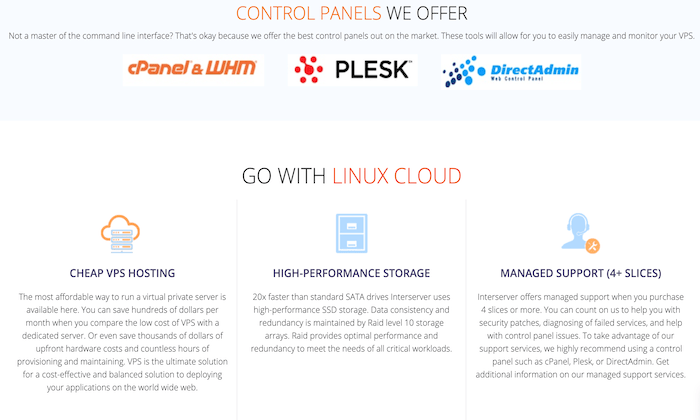
InterServer definitely isn’t the most well-recognized name in web hosting. But for those of you who want a cost-effective VPS plan, InterServer is worth taking a closer look at.

This hosting provider offers managed and unmanaged VPS hosting, starting at just $6 per month.

Let’s takes a closer look at some of the features, benefits, and highlights of using InterServer for VPS hosting:

  • 450+ cloud apps supported with one-click installs
  • No limits on accessing or updating data
  • Full root access with total control of your OS and control panel
  • Automatically redirect server issues to another node
  • 99.9% uptime guarantee
  • No fees for incoming or outgoing site transfers
  • Remote backup service to keep data safe and secure

Unlike other hosting providers on the market today, InterServer doesn’t offer a free trial or any money-back guarantees. However, they do offer month-to-month pricing, so you can cancel at any time.

The performance of these servers won’t be as high as some of the other plans on our list. But when you’re paying rock bottom rates, top of the line performance probably isn’t your first priority. 

#6 – Liquid Web Review — The Fastest VPS Hosting Services

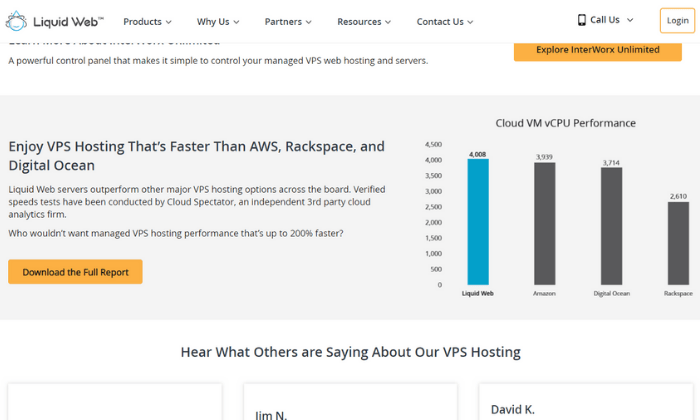
If you’re interested in improving site speed, upgrading to VPS hosting is an excellent place to start. However, Liquid Web‘s VPS hosting services are the fastest in the industry.

While that seems like a bold claim, a third party conducted various speed tests and found that Liquid Web outperforms the competition thanks to their cloud virtual machines.

In turn, your users get a better experience with snappy load times.

Information about Liquid Web's speed test

On top of blazing fast speeds, you also get:

  • Up to 10 TB of bandwidth
  • 100+ GB of solid-state drive storage
  • Best-in-class 24/7 customer support
  • Off-server backups
  • Multi-level DDoS protection
  • Proactive site monitoring
  • Plesk or cPanel

Plus, you have complete control over your website with root-level access, one-click downgrading and upgrading, and total server control.

You can also choose between managed or unmanaged, with full management being an extra $10 per month. This is a smart and affordable choice if don’t want to worry about updates and continuous management on your part.

Liquid Web plans start at $80 per month for Windows and $35 per month for Linux.

#7 – Bluehost Review — The Most Feature-Rich VPS Hosting Service

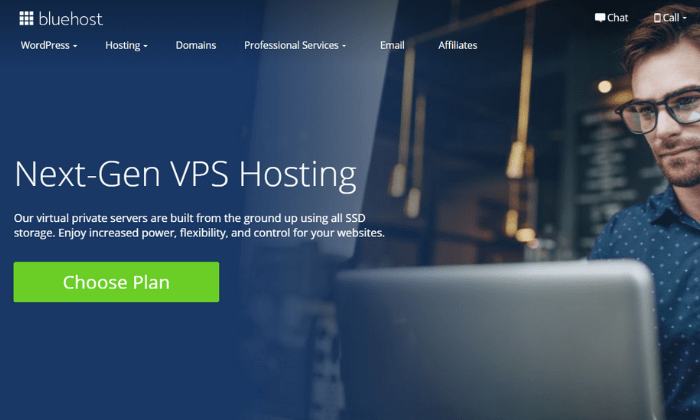
Bluehost is my favorite web hosting provider, so it’s no surprise they make the cut for best VPS hosting as well.

It’s an excellent choice if you already use Bluehost and want to upgrade to a better hosting solution. However, it’s also great if you’re looking for a feature-rich and affordable VPS hosting provider.

Bluehost VPS hosting

Each plan comes with dozens of powerful features, including:

  • A free domain name for the first year
  • A 30-day moneyback guarantee
  • Free SSL certificates
  • Root access via cPanel
  • OpenStack and KVM open-source technology
  • Immediate provisioning for instant server activation
  • Guaranteed resource availability
  • Dynamic resources for traffic spikes
  • Multi-server management capabilities
  • Advanced file management

So, not only do you benefit from award-winning customer support, but you also get a massive bang for your buck and tons of features not available with other similarly priced offers.

With that said, you will have to pay separately for domain privacy and protection.

Bluehost VPS hosting starts at $18.99 per month for two cores, 30 GB of solid-state storage space, 2 GB of RAM, and 1 TB of bandwidth.

#8 – Hostinger Review — The Best Semi-Managed VPS Hosting

Hostinger‘s well-known for their ridiculously cheap shared hosting plans. However, their VPS hosting plans are a smart choice for budget-conscious users looking for a semi-managed solution.

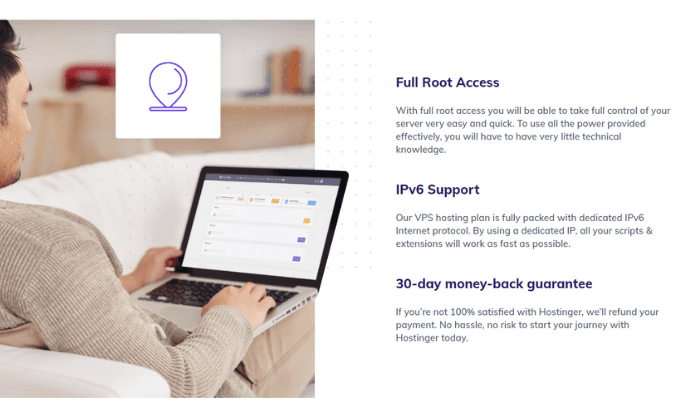
With semi-managed hosting, you handle the back-end stuff with your website, but Hostinger handles server management and other server-related issues.

So, you do get some help, but you get a discounted price in exchange for managing certain aspects on your own.

Hostinger VPS features overview

Plus, you also get dedicated resources and more control, which typically come with VPS hosting solutions. However, you’re getting them at much more affordable prices.

On top of that, Hostinger also providers:

  • A 30-day moneyback guarantee
  • Easy Web Script and an OS installer
  • A dedicated IP address
  • Data backups with double RAID protection
  • An easy-to-use control panel
  • Full root access

So, despite the lower cost, you still get the top benefits of VPS hosting.

Hostinger VPS plans start at just $3.95 per month. However, that plan’s pretty limited in space and RAM. So, you may want to start with their second-tier plan at $8.95 per month.

Summary

VPS (virtual private server) hosting is an excellent option for sites that have outgrown a shared hosting plan. 

Which VPS is the best? Naming just one as the top pick is a tough call. But you’ll be happy with any of the options on this list. Just make sure you follow the methodology described earlier in this guide for choosing the best VPS plan. 

For self-managed and managed plans alike, there’s something for everyone on my list.

The post Best VPS Hosting Plans appeared first on Neil Patel.


from Blog – Neil Patel https://ift.tt/33Cv9Ar
via IFTTT
Tuesday, 8 September 2020

The Marketer’s Guide to Gain Brand Mileage on Google Maps

maps

Are you a local business that serves customers at a physical address?

Then you must snatch the golden opportunity to grab consumer attention with the ultimate local guide, on a mobile device including the iPhone and iPad as well as all Android device products.

  • ⅓ of mobile searches are based on location.
  • Overall, local searches are growing 50% faster than overall mobile searches.
  • As of 2013, 70% of searchers used the “click-to-call” function directly from the search engine result pages (SERPs).
  • Searches including the phrase “best place to buy” with the applicable product or service keyword grew by 70% between 2015 and 2018.
  • “Near me” searches also rose by 500% in recent years. These include searches like “car dealerships near me” and “wedding dresses near me.”

Google also realizes that your business is ‘special.’ And, it released an algorithmic update, in July, 2014, to favor local businesses for neighborhood-focused mobile device queries.

While there are local guide Android app platforms released, in this article, I’ll particularly focus on Google Maps marketing paying attention to the mapping app in an iPhone and iPad as well as any Android device.

Google Maps actually started as a C++ program at Where 2 Technologies. After making a series of company acquisitions, Google started its desktop web mapping service in 2005. Then. in September 2008, the Google maps mobile app was launched on Android.

The application is widely used by commuters for its features like navigation, street view, public transit information, and finding local businesses.  In 2013, the app was the most used smartphone app in the world.

I’ve written about local business marketing and local SEO before. While optimizing your website for Google search results is a good start, there’s still a disparity between map and web search results. So, you might have to separately optimize your business listing in a local guide to appear higher in Google Maps results. Your site needs to link up to the mapping app via your API key.

Furthermore, you can also display your local inventory and purchase space to appear higher on the Google Maps results. Customers are also able to get real-time traffic times to reach you when you incorporate navigation app capabilities.

Let’s get started with Google Maps marketing and drive qualified local traffic to your store even with walking turn-by-turn navigation if you choose.

Ensure that your citations are accurate and optimize your business listing

The first step to making your business easier to find on Google Maps remains the same. Go to Google My Business and claim a listing for your business. This listing will appear in the search and maps results. A site responsive to a mobile device will outperform one that isn’t.

The verification process takes a few days, as Google wants to make sure you are who you say. They’ll send you a physical postcard with a PIN. When you get it, follow the link, enter the pin and get to work.

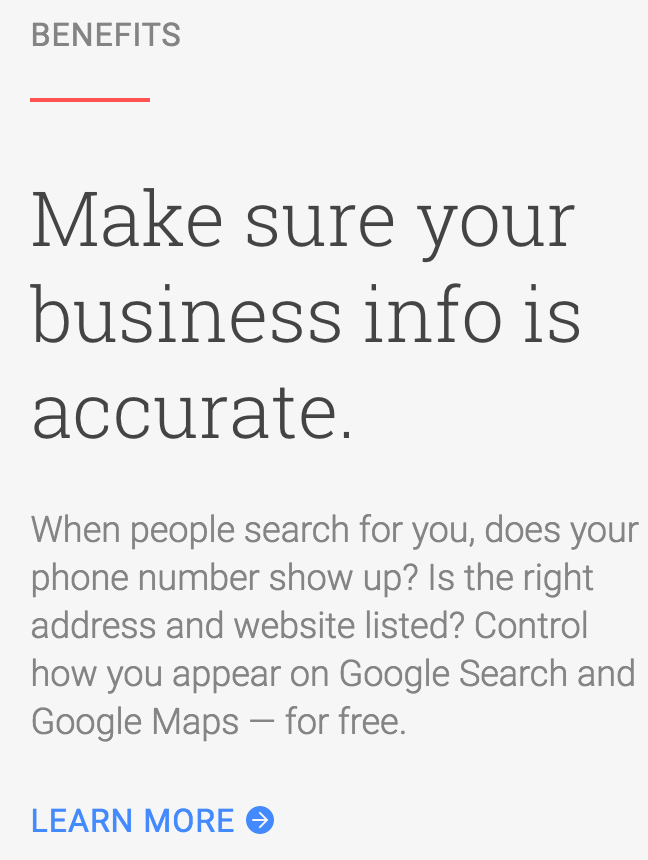
Google emphasizes that the information you provide about your business must be accurate.

image07

Google determines your business location and presents your listings in its results based on the presence and accuracy of NAP – Name, Address, and Phone number (with local area code). On-Page SEO is the simplest marketing ingredient that you need to take care of as a business owner.

image06

But, guess what?

Many local businesses provide incomplete and wrong information. Sadly, they don’t even put the effort to update their local guide listings.

It’s not completely the local business owners fault, though.

You need to take extra care, while providing data about your business. Give your address, right down to your street and floor number. And, it must appear EXACTLY the same way across the internet – on your website and other local directories. Even the formatting of your address should remain the same.

Your business mentions on other listings, like Yelp, are called citations. And, citation inconsistency was found as the number 1 ranking issue for local businesses. Moreover, almost all local businesses were found to have a duplicate Google+ listing (which can lead to ranking penalties).

So, I would recommend checking the business address that you provide to the local postal service. For a more thorough analysis, I recommend reading my article on how to conduct a local SEO audit.

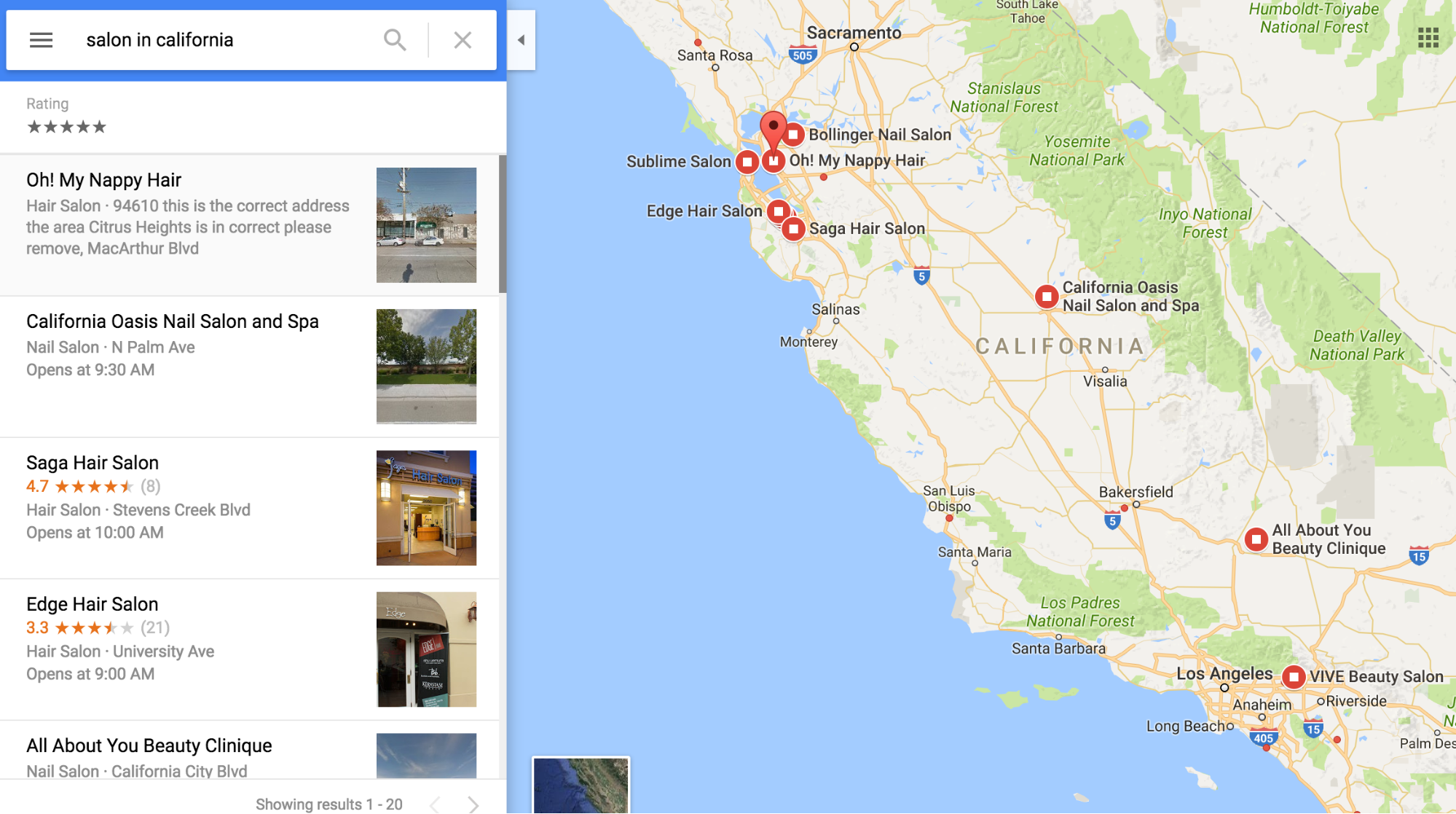
Let’s evaluate the business listing for a salon in California. Here is what I see in Google Maps, when I search for a salon.

image08

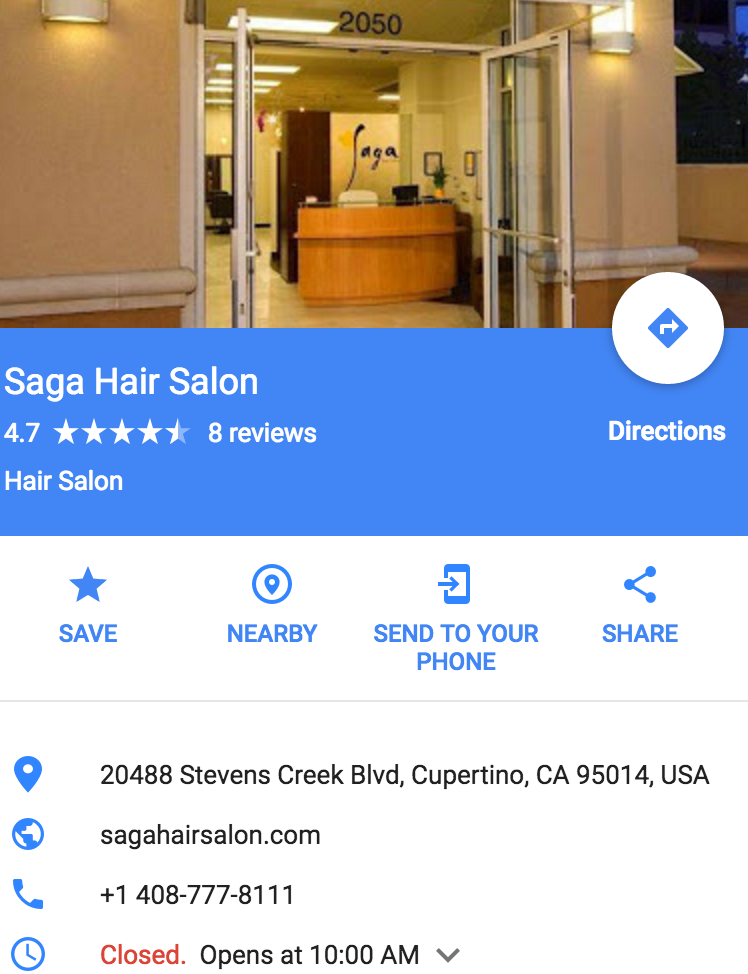
Now, let’s check the info provided by Saga Hair Salon (it’s the first listing with a public rating). The listing provides the salon’s address, operating hours, and contact number, along with their official website. If you scroll down the listing, you’ll also find a few photos that portray the salon well.

You should then add additional photos of your business featuring your interior, exterior, team members, and products. (You probably know this from your own experience searching local businesses, but a Synup study confirms – businesses with photos get 35% more clicks than those without, and they’re twice as likely to be considered reputable by users.) The idea is to help make your business appear friendly and accessible, so add photos that answer the question, “Why should I choose you?”

image04

Now let’s visit their website and cross-check the info. Note that we’re not critiquing the design at this point.

When I visit their site, the same address and contact number appear near the top, in the exact same format. Plus, the information isn’t embedded inside a photo – search engine spiders can access it. So far, so good.

image05

When I scroll to the bottom, I see the same address info, contact and business hours (as listed on Google Maps) as well as an option to go to map view and get directions. Again, a win!

image02

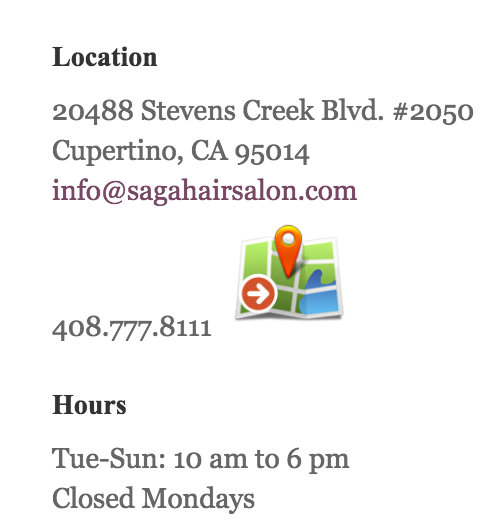
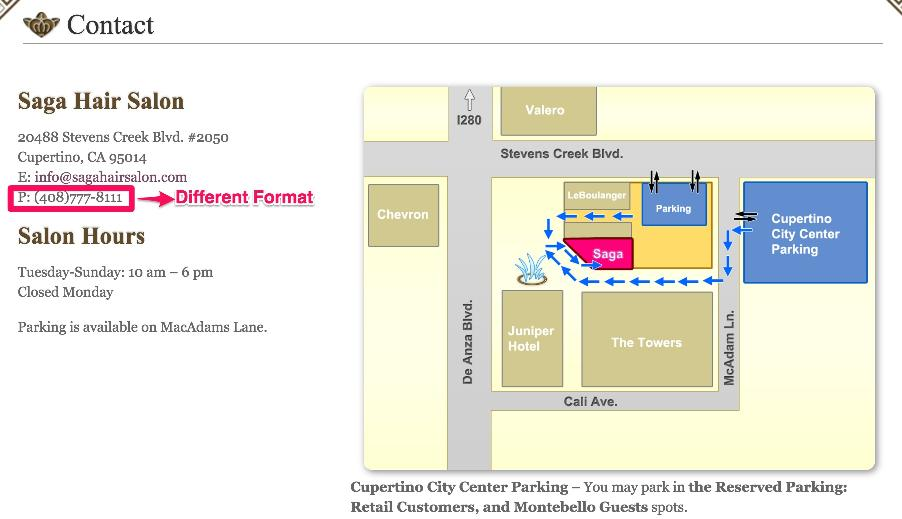
It’s on their contact page that they commit the first mistake. Their phone number is listed in a different format from the other places that we’ve reviewed. And, while the graphic illustrating their location is okay, they could have embedded their Google Maps listing instead.

image01

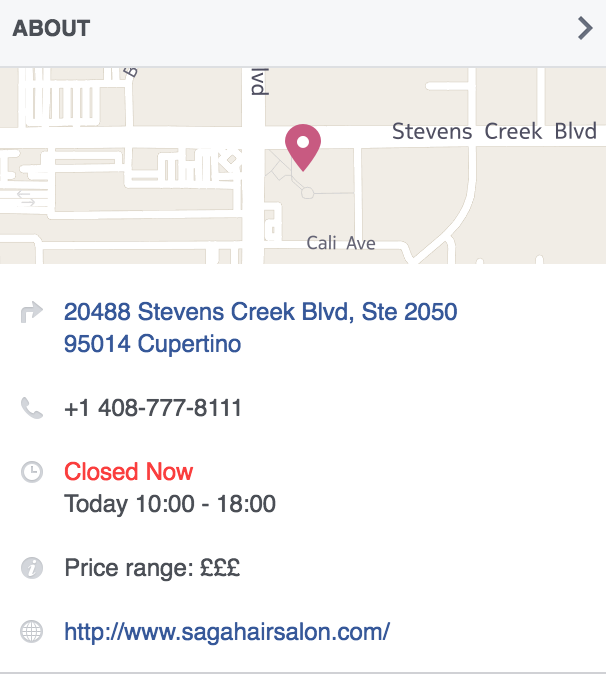
I went on to evaluate the salon’s other online citations, by searching for their business name in Google. Their Facebook page also provides NAP in a different format. And, their Yelp listing states that they are open 7 days a week (although they say that they are closed on Mondays on their website).

image13

Such inconsistent info can hurt a business’ credibility. And, it can also push their listing down in Google Maps results if another optimized business gets their NAP correct across all citations.

I hope my breakdown of the Saga salon gives you perspective on how to conduct your NAP consistency check. After tweaking your listings, check your Google Maps listing once, to ensure that your address and other info is being displayed correctly, especially in a mobile device where formatting can become misaligned.

I would also recommend that you get your business verified (it takes a couple of weeks).

Finally, insert high-quality photos that portray your business in a good light. If the ambiance is important for your customers, then a good photo thumbnail can improve your CTR. And, the customers can also navigate through the additional photos you upload (by scrolling down through your listing).

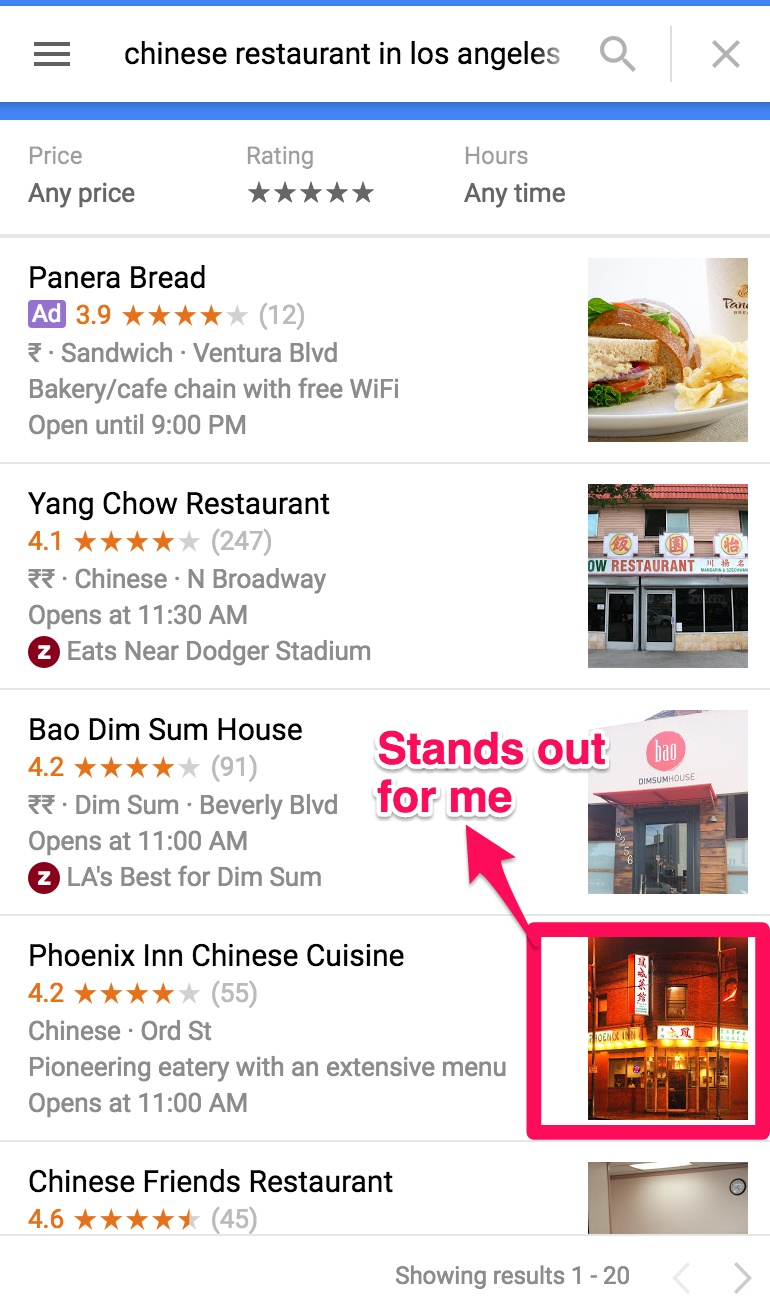
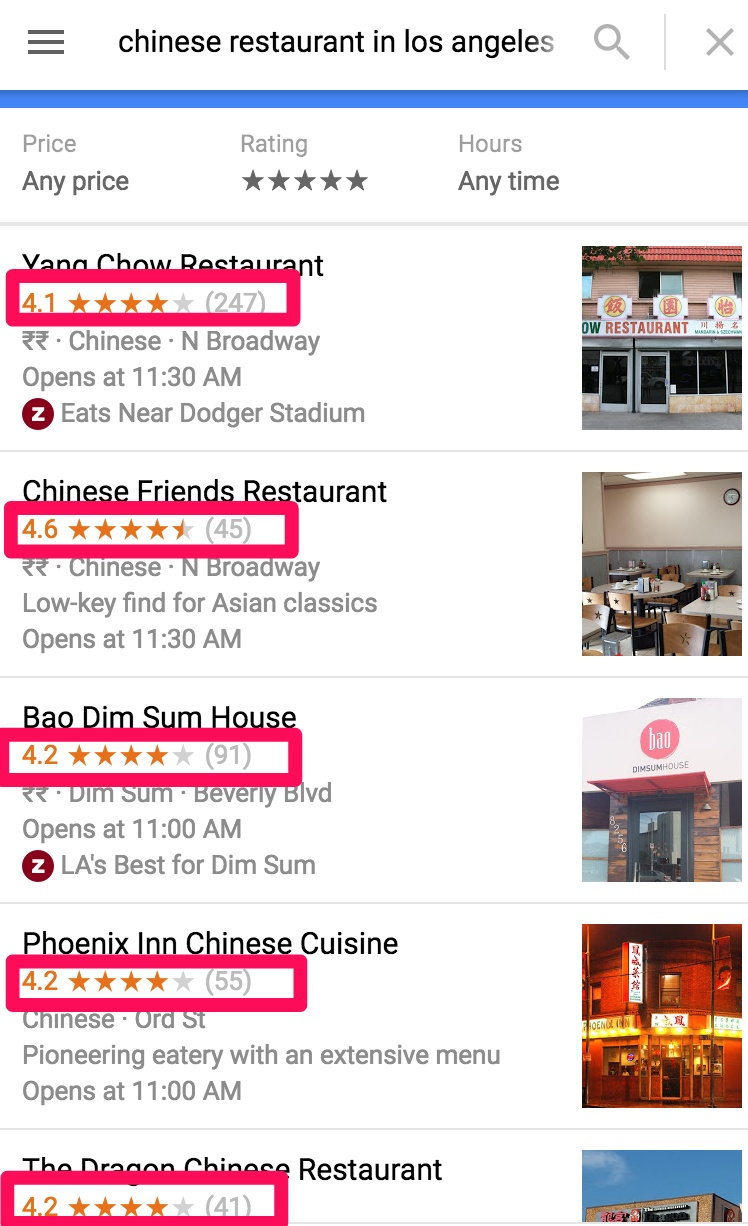
For example, look at the Google Maps results, when I search for Chinese restaurants in Los Angeles. The Phoenix Inn Chinese Cuisine restaurant image immediately grabs my attention.

image09

To further optimize your images, you can also add relevant local info about your business in the alt text and image metadata. There is a Google API key assigned to your business content program, sort of like its own Social Security number, letting Google know that all relevant data spiders find go to your business (and not the Chinese restaurant down the street).

Want a good example of how to complete your Google My Business listing?

Watch the Otis James’ success story below (he brings old-fashioned crafting to people).

Reach for the stars

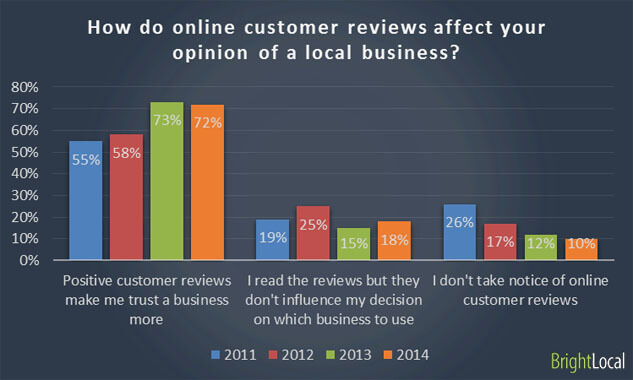
Once you get the basics right, you should request that the customers that visit your store review you. In a Search Engine Land survey, 72% of consumers said that positive reviews made them trust a local business more.

Social proof matters.

image11

The obstacle is that customers are much more likely to post their negative experiences online, rather than positive.

So, first, you need to encourage and remind your customers how easy it is to review your business on their android device, their iPhone and iPad (for those running around town with them).

Second, you’ve got to stay on top of the reviews, with designated customer service folks in place. Understand that only 23% of customers post negative reviews out of vengeance. And, 70% of the people who complain online hope to get a reply.

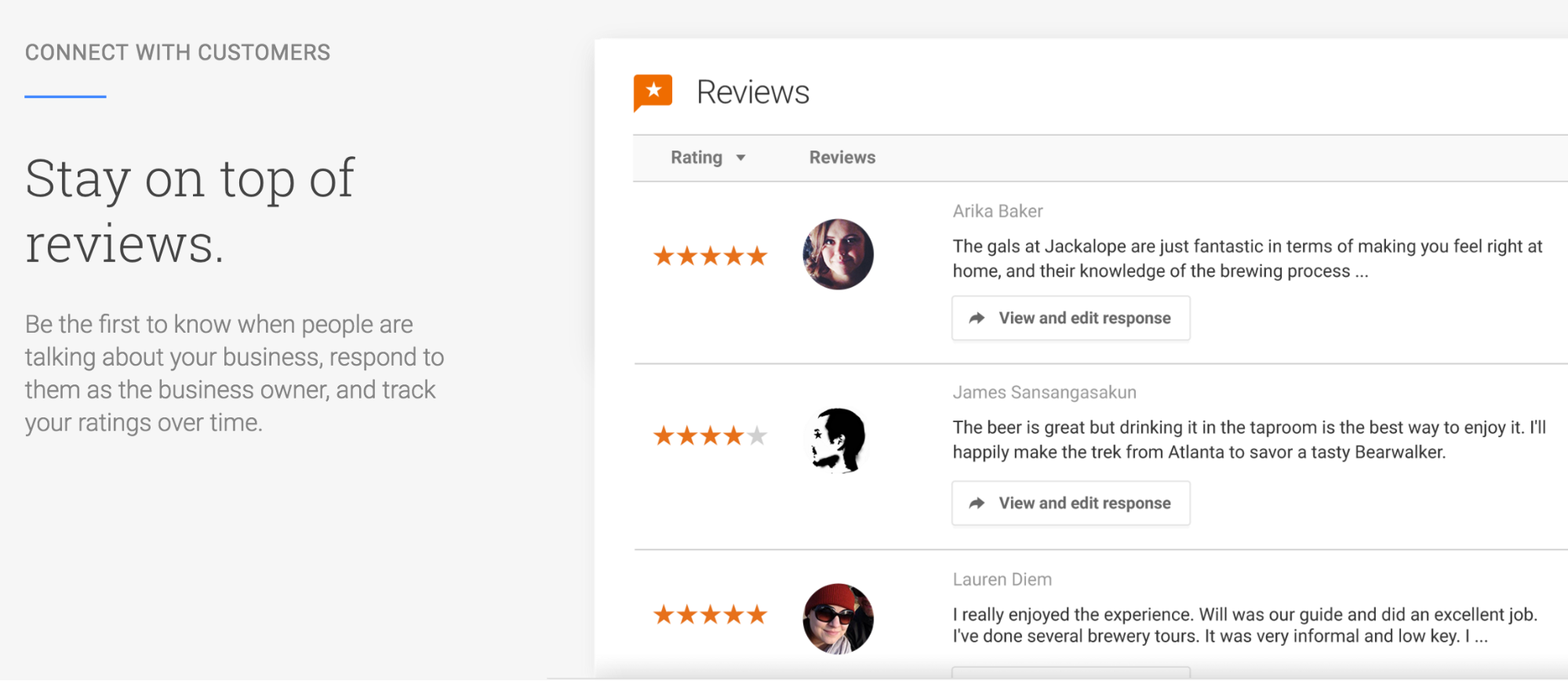
The Google My Business dashboard allows you to easily see all of the new reviews and to respond to them.

image16

If you get a negative review, then don’t launch a personal attack. Be courteous and thank the customer for their feedback. As per Google guidelines, you can also flag a review as inappropriate, if it violates the Google guidelines. But, you can’t edit your negative reviews.

I’ve written in more detail about how to get more online reviews that you can read, here. Remember that a higher number of 5-star reviews alone doesn’t guarantee a higher placement.

The best way to get reviews, especially for salons and other service companies, is to ask for them when interacting with customers in person. Most customers are happy to oblige and consider it an extension of your relationship. Otherwise, you can ask for reviews via email with a link to your Google My Business page in your message. 

You can also “automate” the request by including it in your digital receipt. Payment merchants like Square, for example, allow you to customize your receipts, so you can toss your ask right in that custom field, making you automatically more likely to get reviews. You can simply say, “Love us? Give us a review!” then give a link to leave a review.

Once you have reviews, interact with them. (Because Google wants you to!) It gives Google more content to share with potential customers, which provides the algorithm with a good reason to rank your page higher in the SERPs and on Google Maps. Google offers tips for interacting with reviews here

The exact role of reviews in the algorithm isn’t known. The best that you could do is to check the number of reviews and ratings of the first listing in your industry/locality.

Returning to my search for Chinese restaurants in Los Angeles:

image15

It looks like I can only enter into the top 5 results with at least 40 reviews for my business listing. And, I’ll also need to maintain a rating above 4.

While You’re At It…Optimize All Your Other Review and Social Pages Too

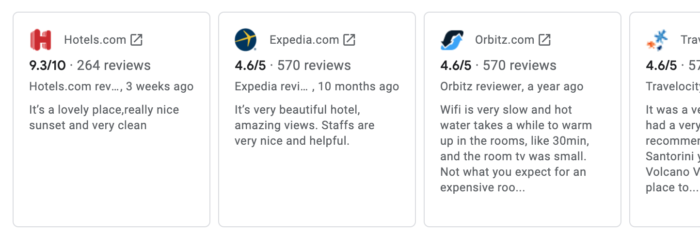
Other review sites, like Yelp, Facebook, Yellow Pages, and TripAdvisor, still matter. You can use the review snippet to pull in reviews from around the web to show up on your SERP listing, and for some businesses, Google links to reviews on other sites. Here’s an example from a hotel listing:

Example of google review aggregator of a greek hotel

This is why you don’t necessarily have to focus exclusively on your Google My Business page when asking for reviews. Users are loyal to their favorite social media and review sites. So make it easier to leave a review by offering a Google Maps review link, but welcome reviews at other sites as well.

Paid marketing avenues: Local search ads and Google Maps Ads

Google has previously experimented with ads inside maps and pushed AdWords location extensions.

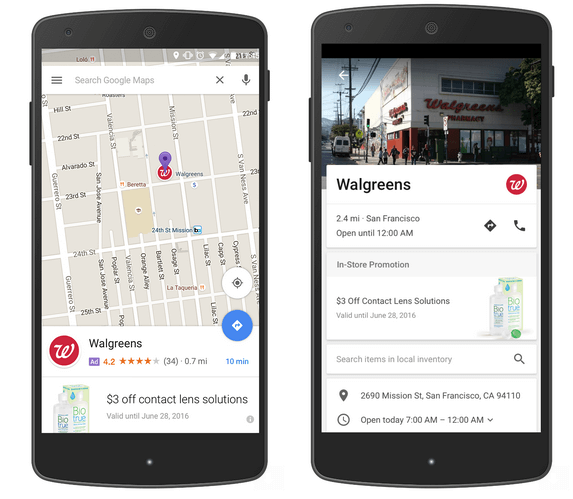
But, at the Performance Summit, Google released new forms of local search ads. The newly launched Google Maps Ads can drive real-time traffic to your physical store with turn-by-turn navigation. The mapping app allows both online and offline map capabilities with easy to zoom map view options.

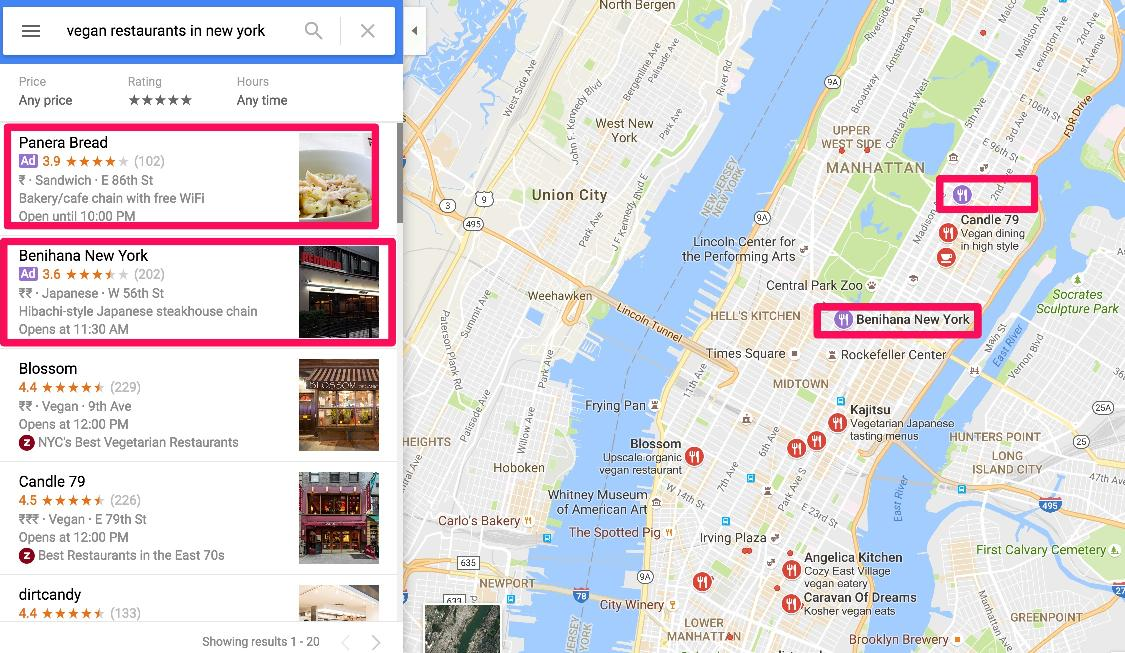
They will appear with a purple ad label, above the organic search results list.  They will also show your business as a purple icon on the map. Here’s an example maps result for a search on vegan restaurants in New York.

image10

And, where will the ads be displayed?

They will be seen in the Google Maps app, as well as the mobile, desktop and tablet sites. They’ll also appear on the location-related searches in the main searches of Google.com – but only for those users that click on the “More places” link, at the bottom of the Local-3 pack.

Note that while Benihana New York and Panera Bread have bought precious real estate and prominent visibility, their ratings aren’t impressive even in the local guide. I am not sure that I’d click on their listing, over the three organic results that have at least a rating of 4.4.

Paid advertisements alone can’t substitute for your organic marketing efforts – they can only amplify them.

You should also know that Google has currently decided to show only two ads above the organic search results. These results will be based on the past user behavior and other signals that ensure that the ad spots are filled with relevant, local guide, listings.

Next, Google plans to introduce promoted pins on Maps with a special API key. Marketers will need to use location extensions to appear in these pins. And, you can attract people into your storefront who are passing by your location.

Here’s how:

Google plans to revamp the local guide pages, expanding their features and even letting businesses add new types of content.

If you’re a retailer, you’ll be able to customize your page to show your available inventory –  you’ll need to send your inventory feed to Google. Here are the local inventory feed specifications from Google.

This will be incredibly helpful for retailers because one in four people avoid store visits when they are unsure whether a specific product is in stock or not.

Showing local inventory actually helped Sears Hometown and Outlet Stores increase their store visits by 122%. You don’t need an Android app to do this, just a highly responsive, well designed, mobile-friendly website. Mobile-friendly means it loads fast and is easy to read on all platforms: an Android device, iPhone or iPad.

Another great feature that you get with the ad is in-store promotion. It’s a space to extend discounts and promotions, entice prospects nearby and encourage visits to your store.

image12

In the future, even small businesses can expect to even see store visits data. It would be made possible with a hardware solution (like beacons). Large brands and retailers already have access to such online-to-offline metrics. As per a case study of Nissan, UK – “6% of mobile ad clicks resulted in a store visit.” The ROI was estimated to be around 25x.

What are the performance metrics for judging the success of your ads?

For your organic marketing efforts:

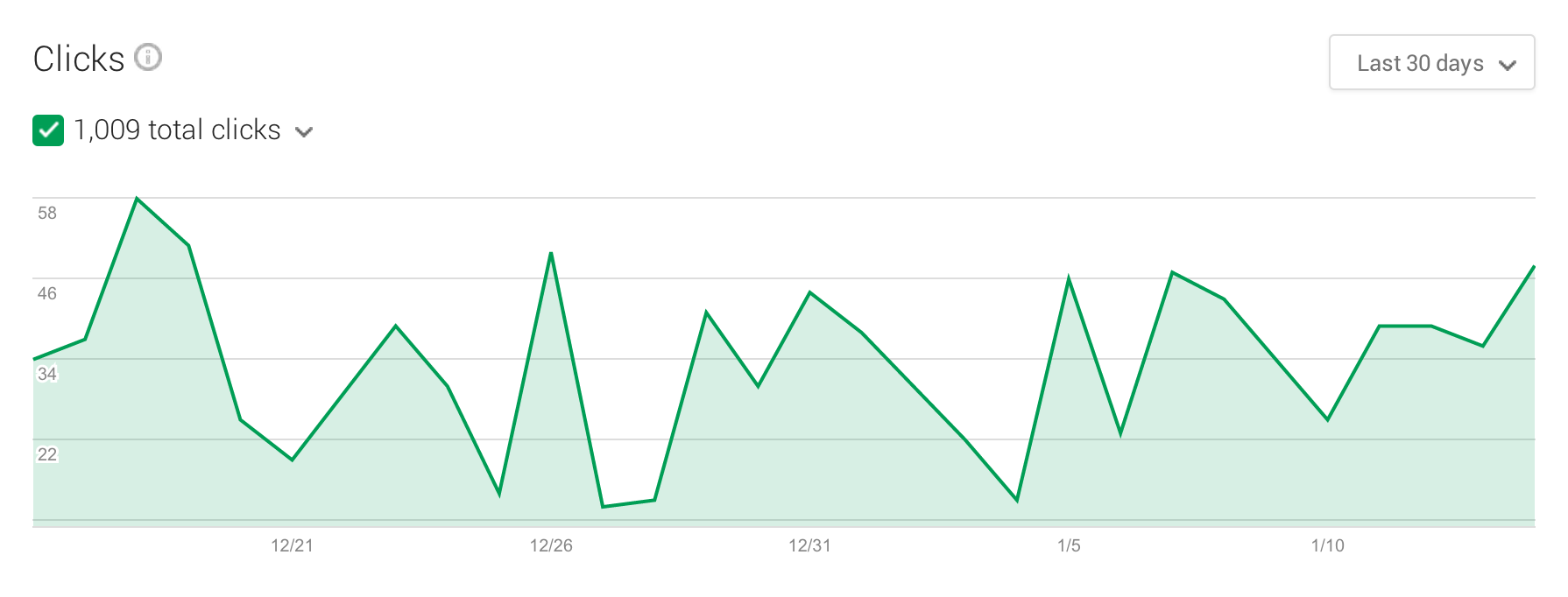
In your Google My Business dashboard, you’re provided with a range of metrics gathered from your unique API key, to see how your business is doing.

You get the number of clicks on your phone number.

image03

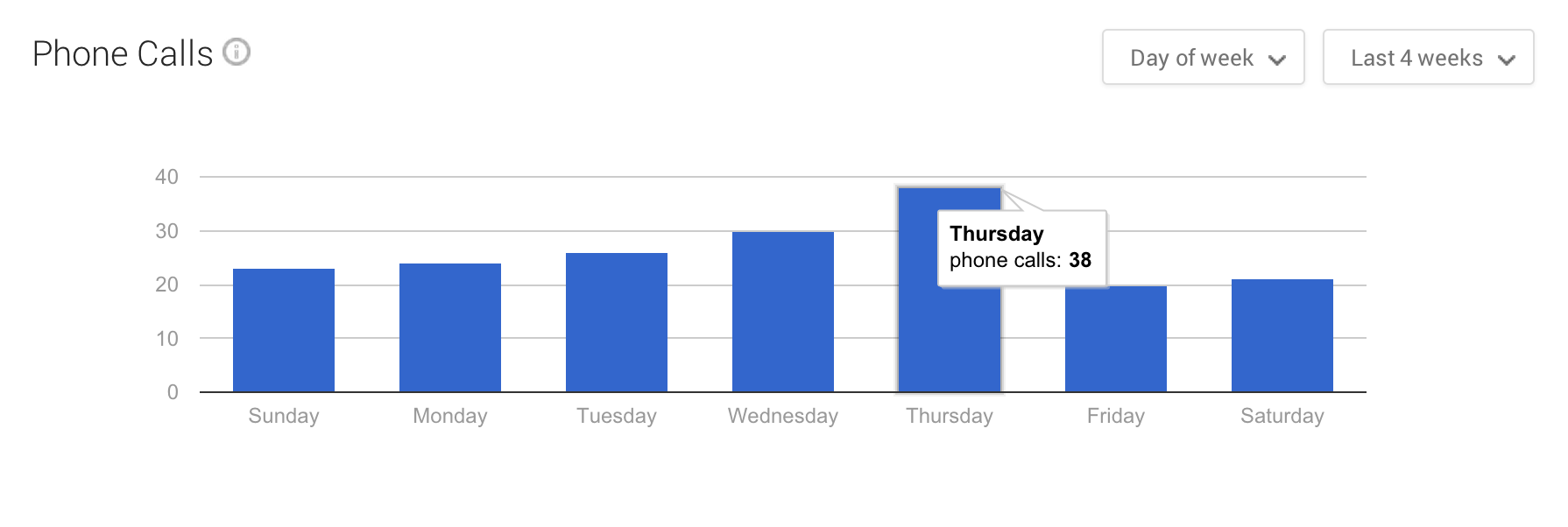
You also receive a breakdown of the phone calls that have occurred on various days.

image14

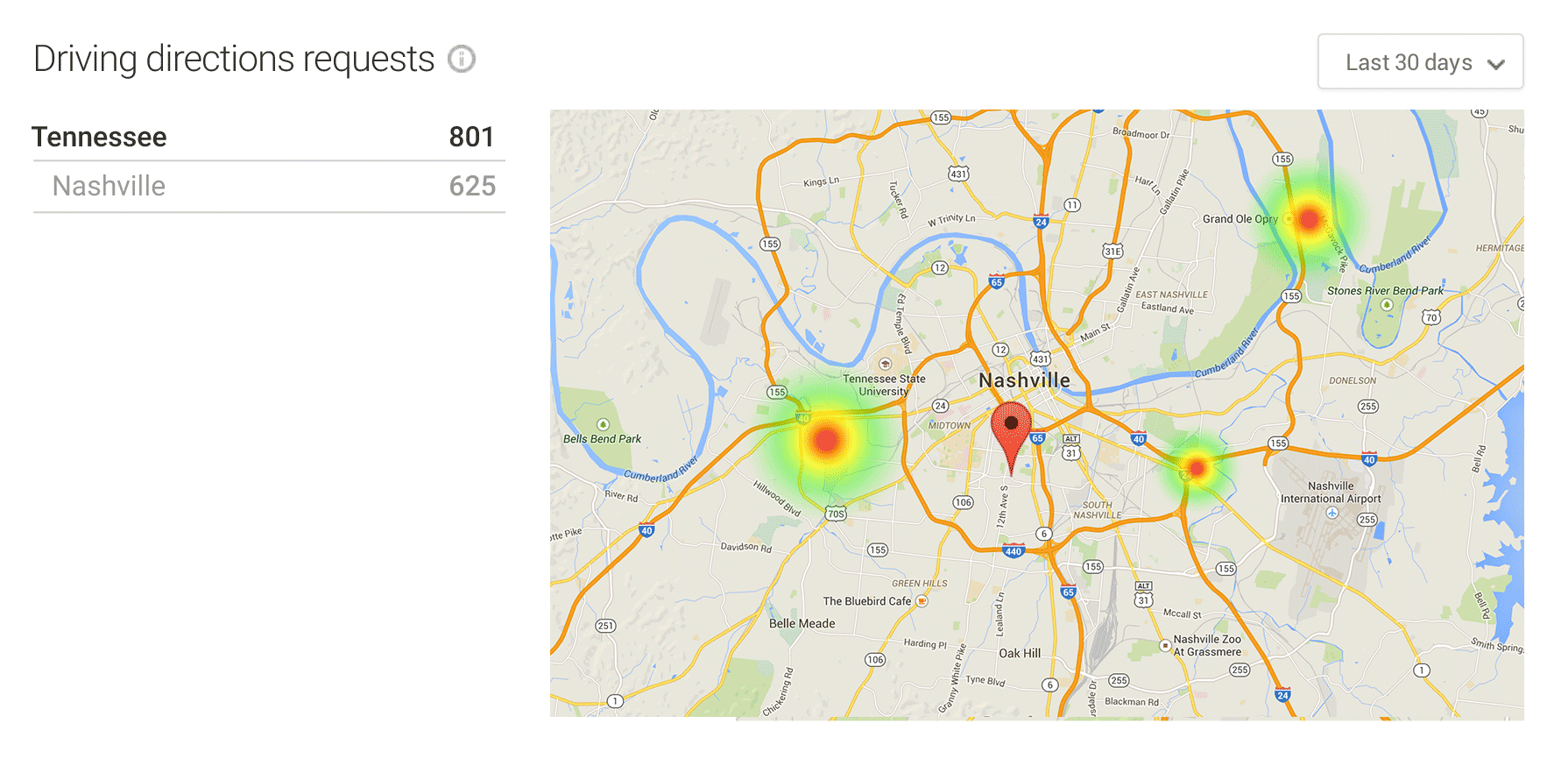
You’re shown the number of clicks by people who are looking for turn-by-turn navigation to your business.

image00

Similarly, search ads can generate 3 types of clicks and are a good way to measure the success of your campaigns.

  1. Get location details – A good indicator of interest in your business,
  2. Get direction – Can indicate how well your ads are driving traffic to your store,
  3. Mobile clicks-to-call – These are precious leads and it’s up to your customer representatives to convert them.

The new Google map ads are still being rolled out to local businesses. You can expect to get access to them soon. A great feature is the offline map to help your consumers save battery juice while getting into the vicinity where they would then move to turn-by-turn navigation app features in real-time.

Conclusion

Google Maps is arguably the most useful app by Google. I would recommend that you start your marketing on Maps by optimizing your Google My Business listing and encouraging customers to review you to raise local guide results. The Google Maps Ads should be rolled out to your AdWords account soon.

One more creative way for travel businesses to use Google maps is give out travel itineraries to their audiences, through custom maps. Even other local businesses can publish local guides with custom maps and attract more prospects, because good old content marketing always works.

How have you been using Google Maps in your local business marketing efforts? Let me know in the comments.

The post The Marketer’s Guide to Gain Brand Mileage on Google Maps appeared first on Neil Patel.


from Blog – Neil Patel https://ift.tt/3hfASAS
via IFTTT
Wednesday, 2 September 2020

Best Accounting Software

Disclosure: This content is reader-supported, which means if you click on some of our links that we may earn a commission.

82% of businesses fail because of poor cash flow management and subpar accounting practices. Yikes. It’s no secret that accounting is hard — and there’s a reason people spend their entire lives learning how to do it well. 

But there’s good news. 

You can avoid becoming a part of this statistic without heading to university to get a Bachelor’s (or Master’s) degree in accounting.

Enter… modern-day accounting software. It exists to help even the smallest businesses improve their bookkeeping processes, save time, and make fewer costly mistakes. 

Plus, understanding your numbers can lead to smarter business decisions and improved overall business health/performance as well.

However, choosing the best accounting software isn’t easy, thanks to the thousands of options on the market. Which one offers everything you need without a slew of confusing features you’ll never use? 

If you’re not sure how to answer that question, you’re in the right place. This article covers how to choose the right software, the different types of software, and my top five recommendations. 

Let’s get started!

The top 5 options for accounting software: 

  1. FreshBooks – Best for freelancers and solopreneurs
  2. QuickBooks – Best accounting software for small businesses
  3. Zoho Books – Best for businesses with 50+ customers/vendors
  4. Sage50 Cloud – Best desktop accounting solution
  5. Wave – Best free accounting software

How to choose the best accounting software for you 

There isn’t a one-size-fits-all accounting solution for every business in every industry. Furthermore, the size and complexity of your business play a role as well. 

Because of this, it’s critical to understand your budget and software requirements before making any decisions. To help you out, these are the criteria I considered when creating this list. 

Feel free to use them as you go through the process of making your final choice. 

Number of clients, vendors, and users

It’s important to consider the number of clients and vendors you manage because certain plans limit the number you’re allowed to have. So be sure to pay close attention to the limitations of each plan before making your final decision. 

Furthermore, you need to know how many user accounts you need as well. Some of the basic plans included in this list limit the number of users to one or two. 

So, you may need to upgrade to an advanced plan to accommodate your needs if you need more than that. 

Mobile accessibility

Make sure the software you choose offers a mobile app so you can manage payments, invoices, and cash flow on the go. It may not seem like an important feature now, but you never know when (and where) you need to access your accounts or send an invoice.

Client management

The best accounting software includes intuitive features that let you follow up on invoices and a portal where your clients can pay you. With internal client management tools, revenue and accounting are centralized in one location to simplify the process. 

Plus, it’s easier on your clients. 

Billing and invoicing

Most accounting software includes invoicing functionality but in different capacities. Some offer highly customizable invoices while others are easier to use with fewer customization options. 

Furthermore, the software you choose should make paying invoices as easy as possible for your clients. Some other billing and invoicing features to consider include:

  • Automatic payment reminders
  • Payment due dates
  • Late fees
  • Recurring invoices
  • Ability to save client information
  • Payment processing options
  • One-click payments

Lastly, consider the payment processing fees associated with each software. Most charge a set percentage plus a small fee for credit card transactions and 1% for ACH transfers. 

Receipt management

Many modern accounting tools make it easy to categorize and store digital versions of your receipts. All you have to do is snap a photo of your receipt and attach it to the associated expense in your account. 

However, not every software includes this. So, if this is something you’re interested in, be sure to choose an accounting software with receipt management capabilities. 

Banking

Connecting your bank accounts and credit cards to your accounting software makes account reconciliation a breeze. It also reduces the chances of human errors when making manual entries. 

However, not every software offers this capability on basic plans (but all of my top recommendations do). 

So make sure you opt for a software that includes this functionality.  

Integrations

It’s important to consider the tools you’re already using to run your business. Why? Because the best accounting software for you integrates seamlessly into your tech stack with minimal hassle or headache. 

So before you get started, make a list of everything you need and the tools you already use. 

Then, make sure the top contenders on your list include your full requirements and the necessary integrations. 

You can even schedule a call with a sales rep for each accounting software to walk through your list of requirements to make sure they can handle everything you’re looking for. 

The different types of accounting software

When it comes to accounting software, you have several options. Some of them are better than others, but the best choice for you depends on your situation. 

So let’s walk through your options before we dive into my top recommendations. 

DIY spreadsheets

Spreadsheets are a free, DIY option if you’re on a tight budget. They work okay if you’re just getting started and have a limited number of business transactions. 

However, they’re not a long term solution and they leave a lot of room for human error. 

If you’re looking for a free option, I highly recommend Wave as an alternative. 

Cloud-based accounting software

Most modern-day accounting software is cloud-based, making it easily accessible from anywhere with an internet connection. 

And it’s usually billed on a monthly basis, scalable, affordable, easy to use, and built for small to midsize businesses. 

Every option on this list falls under this category. 

Database accounting software

This is a type of highly secure accounting software specific to enterprises and large businesses. 

It’s very expensive and requires an in-house team of engineers and/or financial specialists to install and maintain. 

Because of that, I didn’t include this type of software in my research. 

Now, let’s dive into my top accounting software recommendations based on the size of your business and your specific needs. 

#1 – FreshBooks Review — The best for freelancers and solopreneurs

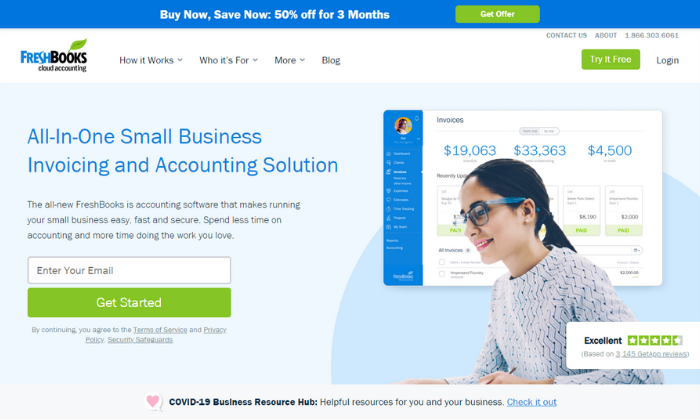
If you’re a freelancer, solopreneur, or small business, FreshBooks is a great accounting software to consider. To date, they serve more than 10 million businesses around the world. 

And the software complies with double-entry accounting standards, providing you with more in-depth insight into your finances and business transactions. 

FreshBooks specializes in invoicing, but the tool also includes small business features, like:

  • Time and expense tracking
  • Recurring invoices
  • Automatic payment reminders
  • Automatic late fees
  • Multiple currencies
  • Project management
  • Client proposals
  • Tax calculations
  • Reporting and analytics

Furthermore, your account dashboard includes a birds-eye view of your business’s financial health. It shows outstanding invoices, total profit, revenue by source, expenses, and unbilled time all in one centralized location. 

Plus, you can manage your books on the go using their robust mobile app. 

And the software integrates with over 200+ business tools like Shopify, G Suite, Stripe, Zoom, Squarespace, and Gusto. So, you don’t have to worry about incompatibility with most of the tools you already use. 

But like most accounting software, FreshBooks charges a transaction fee of 2.9% + $0.30 per transaction for credit cards and 1% for ACH transfers. However, these fees are pretty standard across the industry, and you don’t have to worry about any additional hidden costs. 

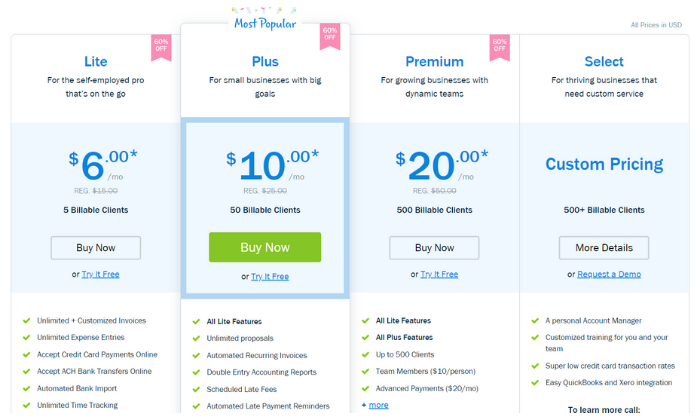
Their paid plans start at $6 per month for up to five clients making it very affordable for freelancers, solopreneurs, and small business owners alike. 

However, FreshBooks can scale alongside your business with other plans, including:

  1. Plus — $10 per month for up to 50 clients
  2. Premium — $20 per month for up to 500 clients
  3. Select — custom pricing for more than 500 clients

Sign up for a free trial to take FreshBooks for a test drive today! Alternatively, you can save 50% off your first three months. However, you have to choose one offer or the other. 

#2 – QuickBooks Review — The best accounting software for small businesses

If you’re running a small business or starting a new business from scratch, QuickBooks is a popular choice — and for a good reason. In fact, over 5.6 million users around the world trust them for their accounting needs. 

From small businesses to self-employed individuals, QuickBooks offers an array of excellent accounting solutions to match your needs. 

Furthermore, you can choose from cloud-based, desktop, or POS system deployment, depending on your situation. However, I highly recommend the cloud-based solution for most businesses. 

Plus, the online software integrates with apps like PayPal, Square, and Shopify to simplify cash flow management in one centralized location. 

With their online solution, you can easily access your account anywhere globally with an internet connection. Plus, you can use the mobile app to take pictures of your bills and receipts rather than filing a heap of paper receipts in your office. 

You also get access to features like:

  • Customizable invoices
  • Income and expense tracking
  • GPS mileage tracking
  • Automatic sales tax calculations
  • Bank and credit card integration
  • Expense categories
  • Standard reporting

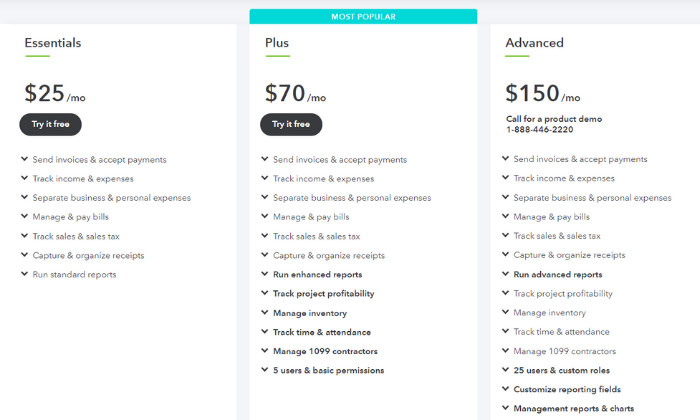
And you can easily upgrade to an advanced plan if you outgrow the basic plan or need more advanced features. Some of their advanced features include 1099 management, inventory management, and time/attendance tracking. 

So regardless of what you need, there’s a plan to suit your needs. 

The cheapest plan starts at $25 per month. And you can add payroll services to your plan, starting at an extra $45 per month + $4 per employee per month with more advanced options available.

Furthermore, QuickBooks charges $0.25 + 2.9% for invoices, 2.4% for swipes, and 3.4% for keyed payments per transaction. Alternatively, they charge 1% for ACH transfers. And you can save up to 40% on transaction fees if you charge more than $7,500 per month. 

Like FreshBooks, QuickBooks offers a 30-day free trial OR 50% off your first three months. 

Get started with QuickBooks today!

#3 – Zoho Books Review — The best for businesses with 50+ customers/vendors

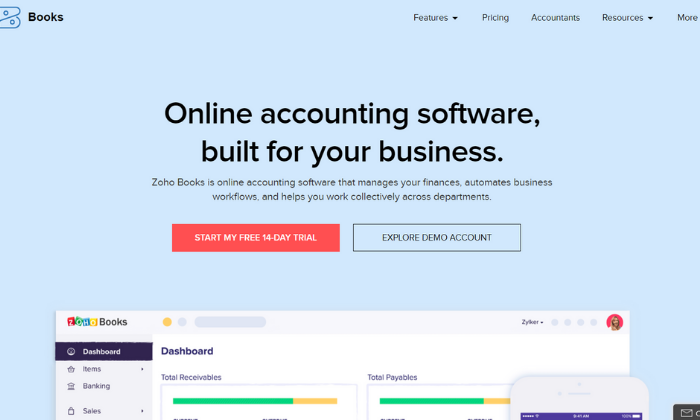
If you manage many clients and vendors, Zoho Books is one of the most affordable accounting software to consider. Their cheapest plan includes up to 50 billable clients, and they also have packages for up to 500 billable clients as well.

So, you don’t have to worry about exceeding your monthly limits. 

Furthermore, Zoho Books includes access to powerful features like:

  • Tax compliance tools
  • Custom quotes and estimates
  • Automatic payment reminders
  • Vendor and expense tracking
  • Inventory management
  • Automatic bank feeds
  • Time tracking
  • Customizable invoices
  • Role-based access
  • 40+ integrations

Zoho Books also offers an intuitive mobile app for managing your accounts on the go. With the app, you can track your mileage, reach out to customers, track your time, create invoices, and more. 

Each plan also includes a private client portal for accepting payments, unlimited phone and email customer support, free SSL encryption, and open rest APIs to connect with third-party applications. 

Furthermore, Zoho offers a wide range of other business tools that integrate seamlessly together. Running a subscription-based business? Or need advanced inventory management? Maybe you need extensive expense reporting for your team. 

Odds are, Zoho offers what you need. You can bundle tools together to save money and create a custom business management system for your business. 

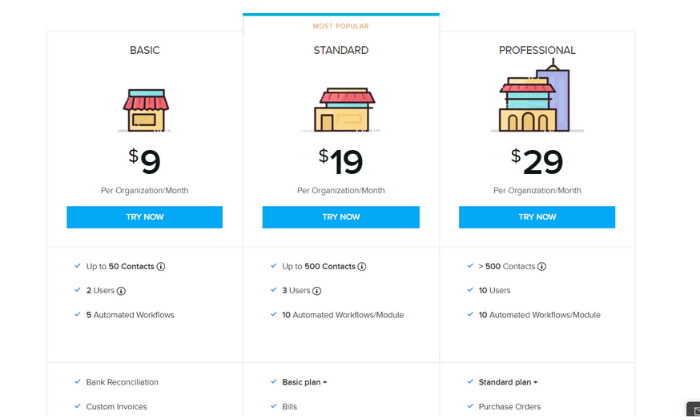
I highly recommend starting with the Basic Plan ($9 per month) and upgrading to an advanced plan when and if you need to. The Basic Plan includes up to 50 contacts, two separate user accounts, and five automated workflows to simplify your accounting processes. 

Zoho’s advanced plans include:

  • Standard — $19 per month for up to 500 contacts
  • Professional — $29 per month for more than 500 contacts

All of which are very affordable for businesses of all sizes. Furthermore, you can add extra users and 50 auto-scans for $2/month and $5/month, respectively. 

Sign up for a 14-day free trial to see if Zoho Books is right for you today!

#4 – Sage 50Cloud Review — The best desktop accounting solution

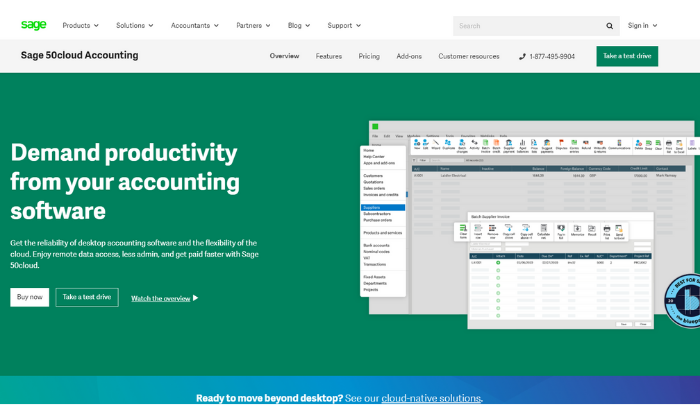
Sage 50Cloud is a desktop accounting application seamlessly connected to the cloud. So, you get the speed and reliability of a desktop software paired with the flexibility and remote accessibility of using the cloud. 

Furthermore, Sage offers cloud-based accounting software, so you’re not limited to the desktop application if that’s not your thing. However, their desktop solution is where they really shine. 

You can securely access your accounts anywhere, anytime, allowing you to work when you want and how you want. So, you’re not limited to your desktop computer despite the benefits of using desktop software. 

Plus, as the #1 rated accounting solution for small businesses, it includes features like:

  • Cash flow management
  • Flexible invoicing
  • Recurring invoices
  • Pay Now functionality
  • Accounts payable + banking
  • Automatic reconciliation
  • Advanced inventory management
  • Job and project costing
  • Payroll processing

As you can see, Sage 50Cloud includes a robust set of features you typically have to pay extra for with the other options on this list (i.e., payroll). 

And with those advanced features comes an advanced price tag. 

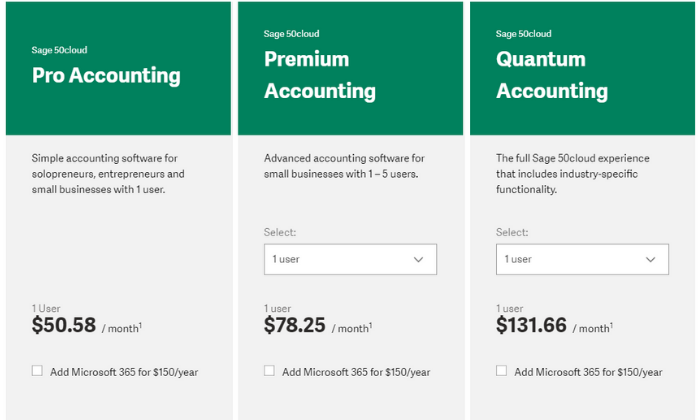
So if you’re looking for basic accounting software, you’re better off going with FreshBooks or QuickBooks. However, if you need these advanced features, pricing starts at $50.58 per user per month. 

Their paid plans include:

  • Pro Accounting — $50.58 per month for simple accounting
  • Premium Accounting — $78.25 per month for advanced features
  • Quantum Accounting — $131.66 per month for all features

However, you can save a bit more by choosing an annual plan and paying in advance. Additionally, you can subscribe to Microsoft 365 for an extra $150 per year. 

You can try Sage’s cloud-based accounting software free for 30 days with no installations and no credit card required. After that, you can purchase Sage 50Cloud if it’s a good fit for your business. 

Get started today!

#5 – Wave Review — The best free accounting software

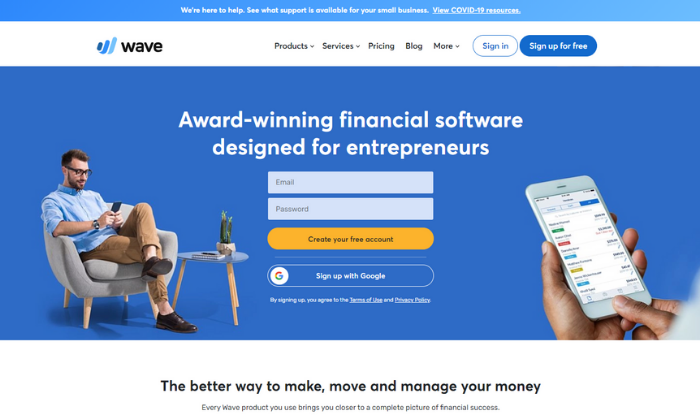
If you have a tight budget or need a simple accounting solution, Wave is an excellent choice. It’s an award-winning finance software for entrepreneurs and businesses of all sizes. 

Plus… their accounting features are entirely free with no hidden fees or monthly payments. However, they charge a standard transaction fee of 2.9% (3.4% for American Express) + $0.30 for credit cards and 1% for ACH transfers. 

You can also add payroll services starting at $20 per month. But accounting, invoicing, and receipt scanning are all free forever. 

This free accounting software includes features like:

  • Unlimited income and expense tracking
  • Unlimited collaborators and accountants
  • Double-entry accounting system
  • Powerful reporting and analytics
  • Bank + credit card connections
  • Tax categories
  • Recurring invoices
  • Automatic payment reminders
  • Unlimited receipt scanning
  • 2-business-day payouts

Plus, you get unlimited email support, as well. And if you’re wondering how Wave stays in business, it’s through their transaction fees and payroll services. So, yes. The software really is free forever, with no hidden fees. 

Furthermore, you can download Wave’s mobile app to access and manage your accounts on the go from anywhere with an internet connection. 

Sign up for a free account to get started today!

Summary

I recommend FreshBooks (for freelancers and individuals) or QuickBooks (for small teams). These two solutions are suitable for most users. They’re incredibly affordable, easy to use, and scalable. Plus, they include all your essential accounting features.

And if you’re on a tight budget, Wave is an excellent free alternative. 

However, the best accounting software for you depends on what you need and what you can afford. So, feel free to use the characteristics we talked about as you go through the process of choosing the right software for your business. 

What’s your favorite accounting software?

The post Best Accounting Software appeared first on Neil Patel.


from Blog – Neil Patel https://ift.tt/31SlWUT
via IFTTT
CPA Cash Machine